
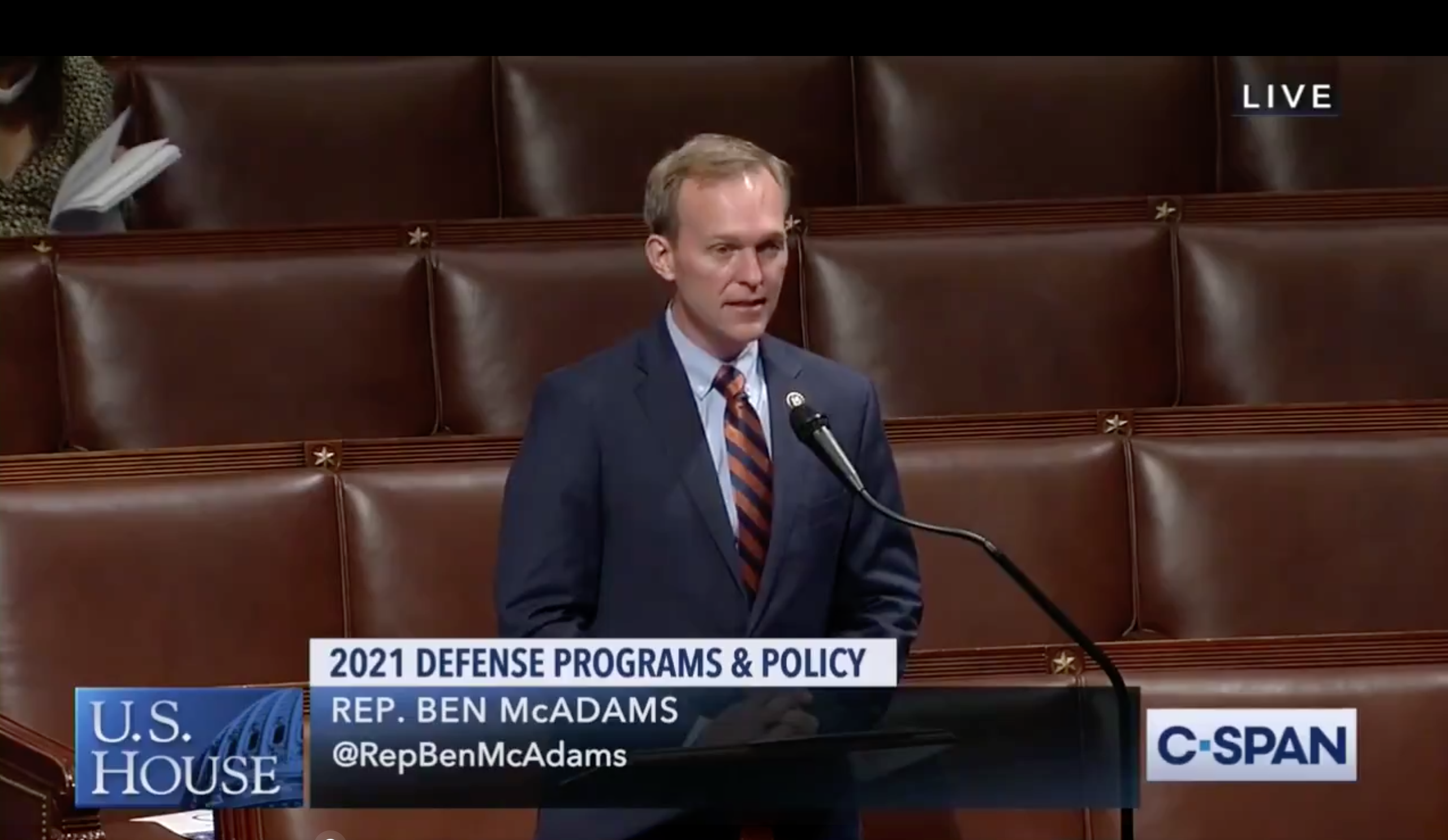
This is the first half of an interview on July 10th with Ben McAdams, representative from Utah’s Fourth Congressional District, about some of the legislation he’s recently sponsored. The second part of the interview can be found here.
Charles Bonkowsky: So I wanted to talk to you about some of your recent legislation you’ve signed onto or sponsored. Some of that you’ve talked a lot about recently is your push to ban—to prohibit nuclear weapons testing in the spending bill.
Ben McAdams: Yes.
CB: Do you want to talk a little bit about why you think that’s so important?
BM: Yeah, I’d be happy to. So, Utah has a—a long history of nuclear testing. One of the primary sites for testing nuclear weapons in the 50s, 60s, 70s, and 80s, so almost four decades, was in the Nevada desert. So they tested almost a thousand nuclear bombs in the Nevada desert, and in many cases, that spread fallout over Utah. And so many people who we call “downwinders”, people who were downwind from those tests, have developed cancer and are dying from their exposure to nuclear fallout from the testing. And the government, all that time, had a very active propaganda campaign telling people that it was safe, there was nothing to worry about from these tests, and ultimately, you know, it came out that they were lying, that the government knew that these tests were deadly and simply misled the public on that so they could conduct the tests.
And so the United States Congress passed a law in 1992 called RECA—R-E-C-A, which stands for Radiation Exposure Compensation Act—and it provided compensation for many of these downwinders who were exposed as a result of the tests. So, RECA is set to expire in 2022, and there’s still a lot of people—we know now, because of medical science, that the exposure is much broader than we even anticipated, and so the numbers of people who were impacted by this is large, and ongoing. And so, while RECA is set to expire, I am cosponsoring legislation that would extend RECA to the year 2045 and expand the eligibility for people who weren’t eligible—it was really only applied to about nine counties in Utah, and we’re expanding it to a broader area where we know the fallout went and people were exposed.
So that’s one piece of my effort, and then the other is to stop new nuclear testing. The Trump administration is proposing that the United States again start testing and developing new nuclear weapons. And I—especially Utah’s history with this, I don’t think it’s right for our country to resume nuclear testing and I don’t think it’s good foreign policy and I think the tests need to—that’s not a path we should go down. So [I’m] working to prohibit and block any funds that would go toward nuclear testing in the future. And so we’re working in the appropriations bill—I’ve also introduced an amendment to the national defense authorization bill that would prohibit any funds to go towards new nuclear testing.
CB: Alright. You said the number of people who are getting eligibility is much higher than before. Do you know how many Utahns have been affected by this downwind fallout, or how many would be receiving benefits?
BM: Well, it’s hard to say. We’re looking at criteria: can they establish that they lived in Utah at the time they developed cancer as a result of those tests, so—they’d have to establish their eligibility, but currently, the eligibility is really only limited to the nine Utah counties. We know now that fallout blew into Utah County, into Salt Lake County, really across the entire state of Utah and even into Wyoming and Montana depending on which way the wind was blowing on the day of the test. And so it would expand it to many of those states and then the individuals would have to establish, you know, that they were exposed and developed cancer as a result and then they would be eligible for compensation. I just don’t think it’s right that they’re paying expensive medical bills for cancer diagnosis for something that happened to them because of our own government’s deception.
CB: Do you think this is a partisan issue?
BM: No. The fallout affected Republicans and Democrats alike, you know, and it wasn’t a partisan issue when RECA was adopted in 1992. President Ronald Reagan led on nuclear test ban treaties in the—he made a lot of progress in the Cold War, in stopping nuclear testing and stepping back from the brink with nuclear weapons. And I think this is something we should all care about, Republican and Democrat.
CB: So, something I was wondering about is there’s the amendment on the House bill which would prohibit funds for explosive nuclear testing, and then there’s also the PLANET Act which you’ve cosponsored recently. It seems like they…sort of do the same thing, so just for people wondering, could you explain what the difference between that act and the section in the appropriations bill?
BM: Yeah, they’re actually very similar. The PLANET Act is the language that then got amended into the appropriations bill. It’s more of a strategic approach to it: I’m working to put it in the defense authorization bill as another method to pass it, you know, I don’t know which bill is going to be successful and what avenue is going to be the best avenue for getting these prohibitions on spending for new nuclear testing, where we get that done. So I think it’s just having multiple venues for accomplishing the same goal.
CB: On the topic of nuclear testing, you mentioned foreign policy: what are your thoughts on the international implications—the administration has claimed that this is sort of to deter other countries like China and Russia, strengthen the US position…what are your thoughts on that argument for resuming nuclear testing?
BM: Well, I—I believe in having a strong national defense, that we protect American interests at home and abroad. Nuclear testing—we have, you know, and our national security experts will attest that our nuclear arsenal is robust and more than adequate, and so I don’t think we need new nuclear weapons. The world has also changed; I think the geopolitical dynamic has changed, where before it was the United States and Russia in a cold war and—the landscape has changed now, with so many different entities and risks on the national stage, from terrorist groups to small—state-sponsored terrorism. I’m not convinced that growing our nuclear arsenal adds anything to our national security, and it may distract from other risks to the United States that we should be focused on, national-security risks.
And in regard to nuclear weapons, we should focus on making sure our nuclear test-ban treaties are strong, and that our competitors around the globe are also adhering to test-ban treaties, and let’s hold each other accountable to not testing nuclear weapons, you know, rather than letting everybody walk away from these agreements that we entered into during the Reagan administration.
CB: Yeah—the US has signed onto the Comprehensive Test Ban Treaty, so are you worried that, if we resume our testing, it will be seen as giving other countries the “green light” to resume their own testing?
BM: Exactly.