
Ben McAdams on the Push for Resuming Nuclear Weapons Testing

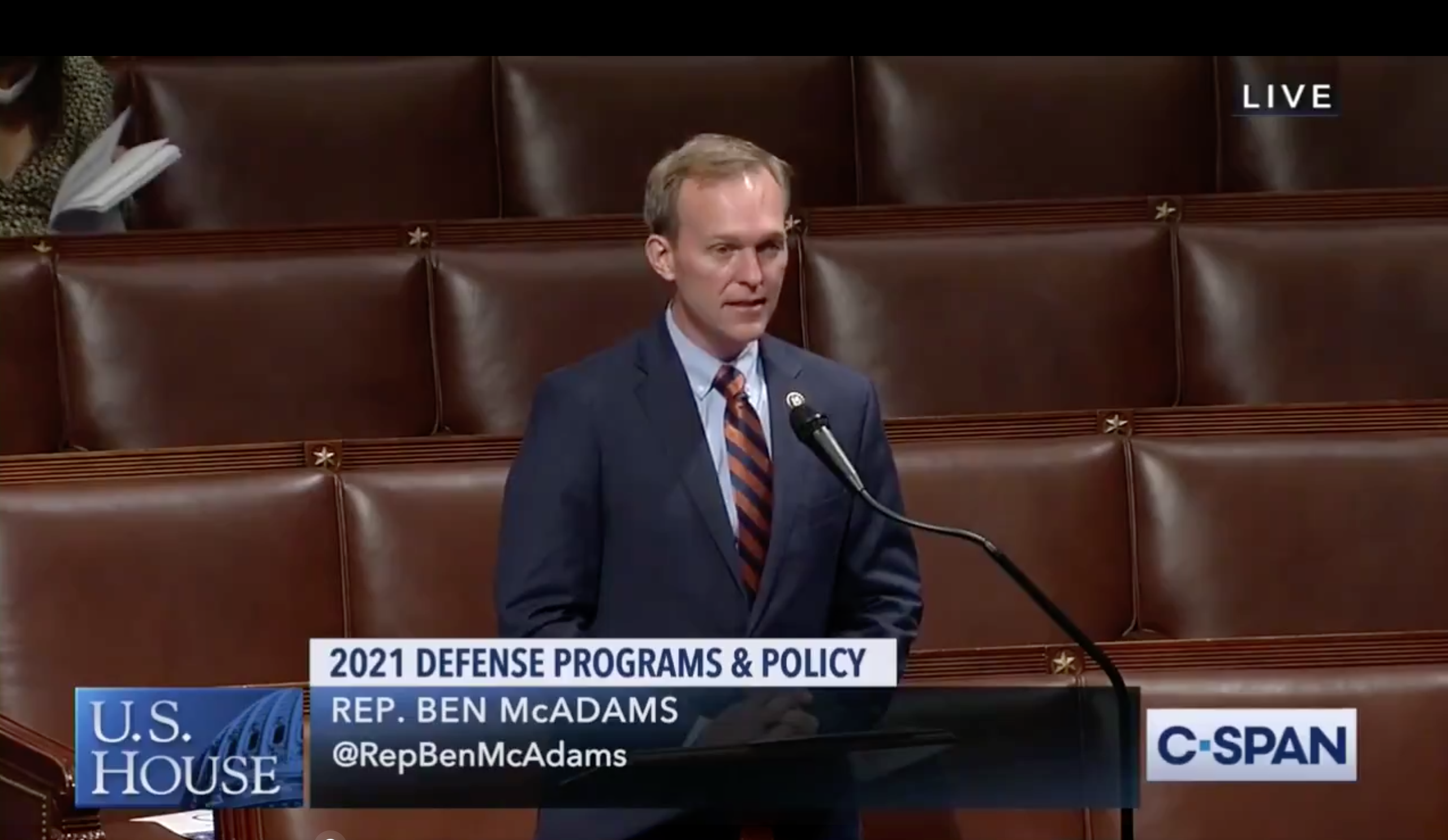
This is the first half of an interview on July 10th with Ben McAdams, representative from Utah’s Fourth Congressional District, about some of the legislation he’s recently sponsored. The second part of the interview can be found here.

Charles Bonkowsky: So I wanted to talk to you about some of your recent legislation you’ve signed onto or sponsored. Some of that you’ve talked a lot about recently is your push to ban—to prohibit nuclear weapons testing in the spending bill.

Ben McAdams: Yes.

CB: Do you want to talk a little bit about why you think that’s so important?

BM: Yeah, I’d be happy to. So, Utah has a—a long history of nuclear testing. One of the primary sites for testing nuclear weapons in the 50s, 60s, 70s, and 80s, so almost four decades, was in the Nevada desert. So they tested almost a thousand nuclear bombs in the Nevada desert, and in many cases, that spread fallout over Utah. And so many people who we call “downwinders”, people who were downwind from those tests, have developed cancer and are dying from their exposure to nuclear fallout from the testing. And the government, all that time, had a very active propaganda campaign telling people that it was safe, there was nothing to worry about from these tests, and ultimately, you know, it came out that they were lying, that the government knew that these tests were deadly and simply misled the public on that so they could conduct the tests.

And so the United States Congress passed a law in 1992 called RECA—R-E-C-A, which stands for Radiation Exposure Compensation Act—and it provided compensation for many of these downwinders who were exposed as a result of the tests. So, RECA is set to expire in 2022, and there’s still a lot of people—we know now, because of medical science, that the exposure is much broader than we even anticipated, and so the numbers of people who were impacted by this is large, and ongoing. And so, while RECA is set to expire, I am cosponsoring legislation that would extend RECA to the year 2045 and expand the eligibility for people who weren’t eligible—it was really only applied to about nine counties in Utah, and we’re expanding it to a broader area where we know the fallout went and people were exposed.

So that’s one piece of my effort, and then the other is to stop new nuclear testing. The Trump administration is proposing that the United States again start testing and developing new nuclear weapons. And I—especially Utah’s history with this, I don’t think it’s right for our country to resume nuclear testing and I don’t think it’s good foreign policy and I think the tests need to—that’s not a path we should go down. So [I’m] working to prohibit and block any funds that would go toward nuclear testing in the future. And so we’re working in the appropriations bill—I’ve also introduced an amendment to the national defense authorization bill that would prohibit any funds to go towards new nuclear testing.

CB: Alright. You said the number of people who are getting eligibility is much higher than before. Do you know how many Utahns have been affected by this downwind fallout, or how many would be receiving benefits?

BM: Well, it’s hard to say. We’re looking at criteria: can they establish that they lived in Utah at the time they developed cancer as a result of those tests, so—they’d have to establish their eligibility, but currently, the eligibility is really only limited to the nine Utah counties. We know now that fallout blew into Utah County, into Salt Lake County, really across the entire state of Utah and even into Wyoming and Montana depending on which way the wind was blowing on the day of the test. And so it would expand it to many of those states and then the individuals would have to establish, you know, that they were exposed and developed cancer as a result and then they would be eligible for compensation. I just don’t think it’s right that they’re paying expensive medical bills for cancer diagnosis for something that happened to them because of our own government’s deception.

CB: Do you think this is a partisan issue?

BM: No. The fallout affected Republicans and Democrats alike, you know, and it wasn’t a partisan issue when RECA was adopted in 1992. President Ronald Reagan led on nuclear test ban treaties in the—he made a lot of progress in the Cold War, in stopping nuclear testing and stepping back from the brink with nuclear weapons. And I think this is something we should all care about, Republican and Democrat.

CB: So, something I was wondering about is there’s the amendment on the House bill which would prohibit funds for explosive nuclear testing, and then there’s also the PLANET Act which you’ve cosponsored recently. It seems like they…sort of do the same thing, so just for people wondering, could you explain what the difference between that act and the section in the appropriations bill?

BM: Yeah, they’re actually very similar. The PLANET Act is the language that then got amended into the appropriations bill. It’s more of a strategic approach to it: I’m working to put it in the defense authorization bill as another method to pass it, you know, I don’t know which bill is going to be successful and what avenue is going to be the best avenue for getting these prohibitions on spending for new nuclear testing, where we get that done. So I think it’s just having multiple venues for accomplishing the same goal.

CB: On the topic of nuclear testing, you mentioned foreign policy: what are your thoughts on the international implications—the administration has claimed that this is sort of to deter other countries like China and Russia, strengthen the US position…what are your thoughts on that argument for resuming nuclear testing?

BM: Well, I—I believe in having a strong national defense, that we protect American interests at home and abroad. Nuclear testing—we have, you know, and our national security experts will attest that our nuclear arsenal is robust and more than adequate, and so I don’t think we need new nuclear weapons. The world has also changed; I think the geopolitical dynamic has changed, where before it was the United States and Russia in a cold war and—the landscape has changed now, with so many different entities and risks on the national stage, from terrorist groups to small—state-sponsored terrorism. I’m not convinced that growing our nuclear arsenal adds anything to our national security, and it may distract from other risks to the United States that we should be focused on, national-security risks.

And in regard to nuclear weapons, we should focus on making sure our nuclear test-ban treaties are strong, and that our competitors around the globe are also adhering to test-ban treaties, and let’s hold each other accountable to not testing nuclear weapons, you know, rather than letting everybody walk away from these agreements that we entered into during the Reagan administration.

CB: Yeah—the US has signed onto the Comprehensive Test Ban Treaty, so are you worried that, if we resume our testing, it will be seen as giving other countries the “green light” to resume their own testing?

BM: Exactly.
How US Nuclear Policy Has Changed

“Every man, woman and child lives under a nuclear sword of Damocles, hanging by the slenderest of threads, capable of being cut at any moment by accident or miscalculation or by madness. The weapons of war must be abolished before they abolish us.”  John F. Kennedy, Address Before the General Assembly of the United Nations, New York City, September 25, 1961.

The path to arms control began with John F. Kennedy in the 1960s. In contrast to his predecessors—one of whom is the only president to order a nuclear strike on another country, and the other who adopted a policy of nuclear deterrence and mutually assured destruction—Kennedy argued for de-escalation or at the very least stabilization of the nuclear situation. His policies saw the adoption of the Limited Test Ban Treaty (LTBT), the first true restriction on the nuclear arsenal, which banned nuclear testing in the atmosphere, outer space, and underwater, but did not place any restrictions on underground testing.

“…reason and sanity have prevailed to reduce the danger and to greatly lessen the fear…The conclusion of this treaty encourages the hope that other steps may be taken toward a peaceful world.”Lyndon B. Johnson on the signing of the Nuclear Non-Proliferation treaty, June 30, 1968.

Kennedy’s policies were continued by Johnson, concerned with averting the specter of nuclear war. He made efforts to reduce tensions in Europe between the United States and the Soviet Union, and his administration signed both the Outer Space Treaty—banning the placement or use of nuclear weapons in outer space or on any celestial body—and the Nuclear Non-Proliferation Treaty (NPT). The NPT was a landmark agreement, which sought to restrict the advent of nuclear weapons to only five countries—the US, USSR, UK, France, and China—and prevent any others from acquiring such weapons.

“Today may well be remembered as the beginning of a new era in which all nations will devote more of their energies and their resources not to the weapons of war, but to the works of peace”Richard Nixon in a televised announcement on SALT I, May 20, 1971.

Though Nixon was viewed as a hawkish negotiator, he too sought détente on the topic of nuclear weapons, and his administration saw the signing of the Anti Ballistic Missile Treaty (ABM) and the Strategic Arms Limitations Talks (SALT I). SALT I saw both countries agree to maintain their nuclear arsenals at current capabilities, though the ABM maintained the ideal of mutually-assured destruction by limiting the number of missile defenses each country could maintain. (Both Nixon and his Soviet counterpart believed that the fragile balance of peace could be disrupted by one side developing an adequate defense against ballistic missiles).

“I believe it is far better to seek negotiations…than to permit a runaway nuclear arms race and risk a nuclear holocaust.”Gerald Ford, February 10, 1976.

Ford continued Nixon’s policies with the Vladivostok Summit on Arms Control, largely seen as a continuation of SALT I. During the summit, the US and the Soviet Union agreed to a limit on the number of aggregate weapons—SALT I had limited the total number of ballistic missiles but not other types of nuclear deployment, and a framework had to be created to account for the fact that the US and USSR had developed different types of nuclear strike systems. However, Ford faced political pushback at home for the summit—Ronald Reagan accused him of yielding to Soviet pressure, and Secretary of State Henry Kissinger stated that many believed “agreement with the Soviets was more dangerous than stalemate, even after a successful summit”.

“Between nations armed with thousands of thermonuclear weapons – each one capable of causing unimaginable destruction – there can be no more cycles of both war and peace. There can only be peace.”Jimmy Carter, on the signing of SALT II, June 18, 1979

Though Carter called for a reduction in defense funding, his administration worked to modernize and develop the US nuclear arsenal in response to Soviet deployment of new missiles. His largest accomplishment in terms of nuclear weapons and treaties was his negotiation of SALT II, which sought to reduce, rather than simply maintain, the number of nuclear weapons the US and the Soviet Union maintained. Though both nations agreed to abide by SALT II, the agreement was never signed, as it was opposed by Republicans and conservative Democrats, and the Soviet invasion of Afghanistan forestalled any talk of agreement.

“A nuclear war cannot be won and must never be fought.”Ronald Reagan, Radio Address to the Nation on Nuclear Weapons, April 17, 1982

Reagan came into office as a critic of arms control, describing the above SALT II talks as “fatally flawed,” but he gradually amended his positions as a result of public opinion and concern about the possibility of nuclear war. He oversaw the signing of the Intermediate-Range Nuclear Forces (INF) Treaty, backed by most European states, which banned weapons with a range of 500-5500 kilometers (as Heather Hulburt states, “The trick about missiles with that range is that, launched from the continental U.S., they don’t hit Russia; launched from Russia, they don’t hit the U.S. Launched from either, they target Europe”).

“For the first time in 35 years, our strategic bombers stand down. No longer are they on ’round-the-clock alert. Tomorrow our children will go to school and….they won’t have, as my children did, air raid drills in which they crawl under their desks and cover their heads in case of nuclear war…the long, drawn-out dread is over.” George H.W. Bush, in the 1992 State of the Union Address, January 28, 1992

The first Bush oversaw the programs known as the Presidential Nuclear Initiatives, which were unilateral steps to reduce nuclear weapons systems at a scale never seen before: bombers were taken off alert, short-range missiles and artillery were withdrawn and destroyed, most naval nuclear weapons were withdrawn, and several nuclear programs were canceled. Bush announced these steps as the Cold War came to an end and the Soviet Union dissolved, though he also signed START I, called the most complex arms-control treaty in history, to reduce the number of nuclear weapons held by both the USSR (once it dissolved, the signatories were Russia, Belarus, Ukraine, and Kazakhstan) and the United States.

“We need to continue the negotiations to reduce nuclear arsenals…We need to stop this proliferation of weapons of mass destruction.”Bill Clinton, in the 1992 Presidential Debates, October 11, 1992.

Clinton’s tenure was marked by a deep opposition to nuclear treaties from a hostile Senate. He signed START II, which prevented the use of potentially destabilizing MIRV weapons on intercontinental ballistic missiles, but by the time the Russians ratified it, the United States would not pass it. He also signed the Comprehensive Test Ban Treaty, which prevented all signatory nations from conducting nuclear tests. Though the Senate once again opposed ratification, Clinton pledged that the United States would abide by its terms and refuse to conduct any nuclear tests—a policy which has been in effect since 1992.

“Our nations must spare no effort at preventing all forms of proliferation”George W. Bush on the signing of SORT, May 24, 2002

In contrast to his father, the second Bush had a much more mixed approach to nuclear policy. As a candidate, he called nuclear missiles “obsolete weapons of dead conflicts” and pledged to make reductions in the US and nuclear arsenals, continuing the push started by H.W.’s Presidential Nuclear Initiatives. He signed the Strategic Offensive Reductions Treaty (SORT), which implemented some of that reduction, though it was criticized for having few benchmarks by which the reduction in nuclear arms could be measured. His most drastic departure from previous policy, however, was the withdrawal of the US from the Anti-Ballistic Missile Treaty and the recommendation by his National Strategies that opened the door for the United States to conduct a pre-emptive strike, rather than using nuclear weapons only as deterrence.

“The existence of thousands of nuclear weapons is the most dangerous legacy of the Cold War…I state clearly and with conviction America’s commitment to seek the peace and security of a world without nuclear weapons.”Barack Obama, speaking to the citizens of Prague on April 5, 2009

In the early years of his presidency, Obama was criticized as ‘idealistic’ for his calls for a world without nuclear weapons, that trying to maintain deterrence and convince other nations to give up their own missiles was an impossible task. And it proved to be. Though he signed New START, which replaced SORT and was seen as a continuation to START I, START II, and START III (the third never left the negotiations stage) that limited the number of warheads the US and Russia could contain, many have concluded that his administration fell short on its goal of non-proliferation. Instead, and in response to Russia’s own actions, the US spent much of the budget allocated to nuclear weapons on modernizing the arsenal rather than pushing for de-armament. And like Clinton before him, he faced serious opposition from Congress, who opposed his 2015 deal with Iran that halted the country’s progress towards obtaining nuclear materials.

“My first order as President was to renovate and modernize our nuclear arsenal. It is now far stronger and more powerful than ever before…there will never be a time that we are not the most powerful nation in the world!”  – Donald Trump on Twitter, August 9, 2017

Against this half-century of bipartisan opposition to nuclear weapons, the multilateral efforts from the United States, Russia, Europe, and other nuclear-armed or -aspiring countries to reduce the arsenals, Trump has dismantled treaties and once again sparked worries of a nuclear conflict with his threats to countries like Iran and North Korea.

As a presidential candidate, Trump was contrasted with Hillary Clinton, who many feared (or at least claimed) would lead the US into another war. His statements on nuclear weapons during the campaign were ever-shifting, but seemed to favor at least some form of disarmament: he stated that “I will be the last to use nuclear weapons. It’s a horror to use nuclear weapons,” and that the biggest problem facing the world was nuclear proliferation; in separate interviews, though, he stated that he “could not take anything off the table”, and would be prepared to use a nuclear bomb in Europe if necessary.

In terms of policy, his administration has withdrawn from many of the treaties his predecessors worked to achieve—allowing the US to upgrade and expand its nuclear arsenal, but also pushing the world towards a more dangerous form of brinksmanship that the Cold War characterized. Early in his administration, he withdrew from the nuclear deal with Iran—the country has since expanded its nuclear capabilities and enlarged its stockpile of enriched uranium. The Trump administration has also left the INF treaty and the Open Skies Treaty, both times claiming that Russia was already violating its terms, and that leaving the treaty would allow a new agreement to be negotiated that would include China as well. So far, no negotiations have begun.

Most recently, the Trump administration has indicated a willingness to move forwards with nuclear testing in violation of the Comprehensive Test Ban Treaty. Once again, it follows as-yet unsubstantiated claims that Russia and China are conducting their own low-yield tests and that the US’ ability to conduct rapid tests is necessary to intimidate rivals into renegotiating any deal between the three powers.

Trump has drawn heavy criticism from congressional Democrats for these moves: Adam Smith, who chairs the House Armed Services Committee, has called for a policy which reduces the number of nuclear weapons and the probability of conflict, and representatives from many Western states where new testing is likely to take place have moved to ban any sort of funding being used for explosive testing; ranking Senate Democrats on the Armed Services, Foreign Affairs, and Intelligence Committees called for the administration to remain in the INF; and the president’s 2020 opponent, Joe Biden, has called the new proposal by the administration “as reckless as it is dangerous.”

The United States has long been seen as the largest arbiter of nuclear policy among countries—and as Senators Jack Reed and Carl Levin wrote in 2004, “the US is more often imitated than obeyed.” Backing out of these treaties gives the US more space to expand weapons capabilities, but it gives that same freedom to all other nations—freedom that, as previous presidents can attest, cannot be easily contained.