
The Democratic primary was largely decided in March (Senator Bernie Sanders dropped out at the beginning of April), but those five months can make all the difference in the world. March marked a time before the US economy contracted by a third, before tens of millions faced housing eviction and protests over another police killing of a Black man rocked every state in the nation.
And during that time, presumptive nominee Joe Biden has seemed to change as well. During the primary, he was defined by incrementalism and the long shadow of his decades in the Senate—but now, his plans and his actions have brought Sanders to describe him as, if those plans are implemented, “the most progressive president since FDR.” Biden himself has stated that, if elected, he and his administration “won’t just rebuild this nation—we’ll transform it.”
But in many ways, Biden’s apparent change is less a radical departure from his positions of the past, and more an acceptance of his position as the standard-bearer of a party that has shifted around him.
Biden Is Historically In The Center (Of The Party)
Biden was first elected to the Senate in 1979, and over that time, many of his views have shifted significantly. In the 1990s, he voted for the Defense of Marriage Act, which prevented same-sex marriages; in 2012, he was the first high-ranking Democrat to endorse it, even before the president. And some of the most contentious points in the primary came over his support for the 1994 Violent Crime Control and Law Enforcement Act and the Anti-Drug Abuse Act of 1988, both of which he has said he regrets.
But his views have evolved with the party. The majority of Democratic senators voted for the Defense of Marriage Act (32 of 46), the Violent Crime Act (54 of 56) and the Anti-Drug Abuse Act (49 of 54). In fact, tracking his voting records through Congress, Biden is dead center of the Democratic caucus:
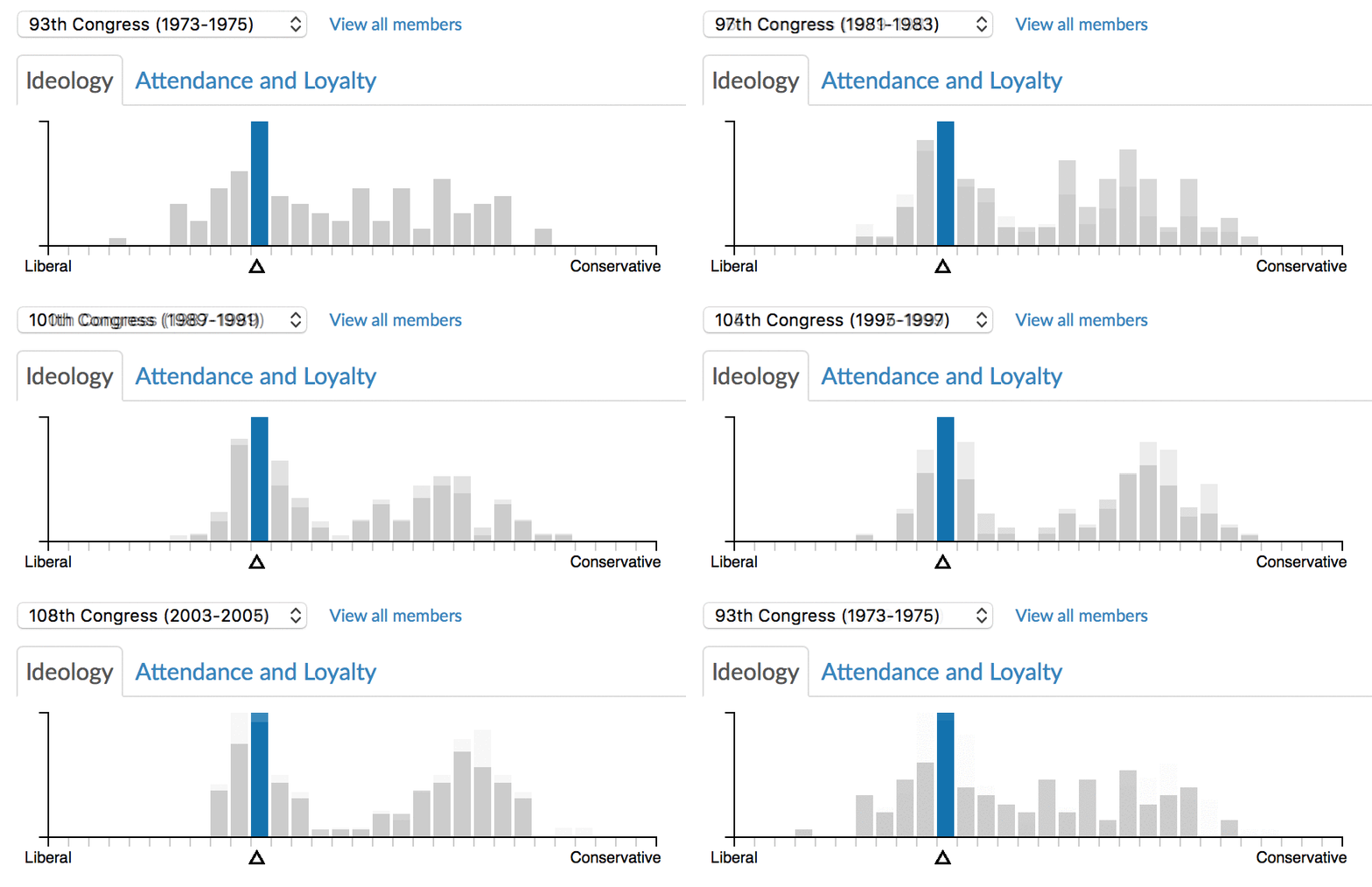
(the left bloc generally represents Democratic senators, the right bloc Republican senators. Biden’s position among them is marked in blue. On average, Biden was more liberal than 51% of Democratic senators and more conservative than 49% of Democratic senators).
So the question of where Biden stands is, in its broadest sense, a question of where the Democratic Party stands—and there’s evidence to suggest that the party is further left than it’s ever been. Even if ideas like Medicare-for-all or the Green New Deal weren’t enough to win the primary, the discussions they sparked in public opinion and the ideas they proposed were the catalyst which carved out the space in which Biden’s plans now fall.
So What Are Biden’s Plans?
Biden’s campaign website features an extensive list of policy plans, many targeted at specific communities. After the primary ended, several of these plans were reworked or added to with input from activists, legislators, and prominent Democratic figures. A joint task force between the more establishment and progressive wings released guidelines on some major policy areas, and what Biden’s plans have become in response:
Education
Biden’s plans on education represent a drastic shift from the Obama-era policy, perhaps driven in response to Secretary of Education Betsy DeVos’ championing of charter schools. In K-12 education, Biden pledges a massive investment in public schools (especially Title I schools in low-income areas; his plan calls for tripling funding for those schools) and teachers, though he has not yet adopted the recommendation of stricter federal oversight on charter schools.
Post-high-school, while Biden has adopted the progressive tenet of free public college for all at least to a degree: his plan says that colleges will be free for families earning under $125,000, and that community colleges will be free for everyone. Beyond that, Biden says that he will work to reform the student loan system to reduce administrative burden and—like many other of his plans—specifically invest in colleges and universities that serve communities of color.
Economy
The task force called for a comprehensive plan that specifically addressed communities of color, which Biden’s campaign has made the fourth pillar of his “Build Back Better” program. Though it does not include some of the policies championed by Sanders and Warren such as a “wealth tax”, it embraces the role of government in creating jobs (and assisting economic recovery in the wake of the pandemic) through the creation of a Public Works Job Corps.
His current economic plan, of which more details are expected to be released soon, is also interconnected with many other areas such as climate change, where Biden’s platform details that infrastructure development will also be designed to electrify and decarbonize much of the US’ existing infrastructure.
Immigration
On immigration, Biden’s plans (and even the task force recommendations) fall most in line with his primary campaign: the idea that, as president, Biden will work simply to undo much of what Trump has done. Much of Biden’s immigration plans amount to a dismantling of the restrictions implemented since 2016, such as the travel bans on Middle-Eastern countries and changes to the asylum system which forced immigrants to wait in Mexico or other Central American countries while their cases are processed.
While Sanders made waves in the primary for calling to abolish ICE and decriminalize illegal immigration (making it a civil penalty rather than a criminal one), Biden makes no such pledges. He calls for expanding the visa system to make more potential immigrants eligible, and creation of an oversight panel on ICE—another sign that, while pushed by the left, he is not the “Trojan horse” for their policies that many Republicans have attacked him as.
Climate
In a primary which saw broad, sweeping climate plans from candidates like Gov. Jay Inslee of Washington and of course the Green New Deal championed by Senator Sanders, Biden was criticized by progressive groups like the Sunrise Movement for being less willing to take bold steps, especially on an issue that many young voters—a weak area for him—care heavily about.
Yet just a few months later, the presumptive nominee’s sweeping new climate plan has been largely hailed by those groups. For one thing, they had a hand in crafting it: Biden’s plan came about as a result of one of his unity task forces between the progressive and establishment wings of the party, including people like John Kerry and Alexandria Ocasio-Cortez, and parts of it are drawn heavily from Inslee’s comprehensive, 200-page-plus path he laid out in the primary.
And it’s likely climate where Biden carves out his path to being the “most progressive president since FDR”. For one thing, it calls heavily for both government spending and investment in public-works programs, and has been supported by large groups of organized labor.
That said, Biden has also made efforts to continue his appeal as a more moderate candidate; in Midwestern states like Pennsylvania and Ohio, he has stated that he will not ban fracking—something that more progressive Democrats have called for and Republicans have attacked them over.
Criminal Justice
Criminal justice and police reform is another issue where the party (and public opinion) has shifted rapidly following the killing of George Floyd and nationwide protests. And once again, Biden has not moved as far left as some prominent Democratic figures: he doesn’t agree with completely “defunding the police”, and has stated that some funding should be “redirected” to less confrontational services such as social workers or mental health counselors, and says that police forces today are too heavily militarized.
His platform is also a repudiation of the bills of the 1980s and 1990s that adopted a “tough on crime” stance, calling for billions in investments to reduce incarceration and end mandatory minimums for nonviolent crimes—an especially important step for a candidate long dogged by his votes for those bills, and as public perception shifts away from the ideals of “law and order” that President Trump has pushed in response to the protests.
Health Care
Joe Biden’s healthcare plan has shifted left as well: he proposes creating a public option for health insurance administered by Medicare. This is most similar to the option presented in the primary as “Medicare for all who want it”—a plan that would not abolish private insurance but allow another option, especially for low-income families or those who don’t receive employer-based healthcare.
Also among his healthcare plans, but less contentious among Democratic voters and activists, are plans meant to prevent pharmaceutical companies from overpricing the drugs and medication that many Americans need: Medicare would directly negotiate the prices for all purchasers, as well as restrictions on launch prices and price increases.
Housing
The pandemic has exposed the cracks in the United States’ housing system, showing just how vulnerable millions of people are to losing their homes when uncertain times hit—it’s estimated that almost 40 million people are at risk of eviction as the federal moratoriums expire. In response, President Trump signed an executive order which instructs the relevant departments to ‘consider’ limiting evictions or providing more money in aid, but doesn’t necessarily force them to do so.
Biden’s plan is founded on the view that even stricter eviction bans are no more than a stopgap measure. It calls for an extension of the Section 8 housing voucher program, which provides vouchers to low-income families that landlords may redeem, that would make it fully universal rather than capped at whatever Congress allocates. Even under normal conditions, it’s estimated that three-quarters of eligible households don’t receive help because there isn’t enough money in the pool, and that isn’t accounting for a pandemic which puts millions more at risk. Making the program universal, like Medicare or SNAP, would mean that—in theory—everyone eligible for benefits would receive them.
Procedure
While not policy-specific, many of Biden’s proposals call for huge investments in government spending, and will face steep opposition in the Senate even if Democrats win a majority in the fall—and, perhaps spurred by the failure of many of Obama’s policies over budget concerns and the filibuster, many Democrats have signaled willingness to end the filibuster and allow deficits to rise, allowing major increases to the national debt.
In a way, Democrats are borrowing here from Republicans’ playbooks to change the rules of Congress when it benefits their party, such as the ending of ‘blue slips’ for judge confirmations and reducing the amount of debate each judicial nominee receives before the Senate must vote on their confirmation. And the same appears to be true of budget deficits and the national debt. Republicans have long held the mantle of the fiscally-responsible party, but the national debt has surged under Trump, and his former chief of staff Mick Mulvaney stated that the party’s position on deficits shifts based on who occupies the White House: “My party is very interested in deficits when there is a Democrat in the White House,” he said in an overseas speech. “Then Donald Trump became president, and we’re a lot less interested as a party.”
Facing such opposition, not to mention the unprecedented economic downturn caused by the coronavirus pandemic, Biden and Congressional Democrats seem less inclined to rein in the budget as they have previously. Even the Blue Dog coalition, a group of moderate Democrats who promote fiscal responsibility, have called the unprecedented government spending “necessary”. And Biden’s plans, calling for trillions of dollars in spending, have only increased in scale—he himself has not mentioned the national debt, but House lawmakers have concurred that now is not the time for it: “We should be using our strong balance sheet to borrow to stimulate the economy. And that may involve more programs like climate and transportation going into the Biden administration,” said Rep. Scott Peters (D-CA), the vice chair of the moderate New Democrat Coalition.
Of course, Biden’s exact approach to procedure will be unknown unless he wins the White House in November. But progressive groups are hopeful that, especially on sweeping legislation such as climate, they won’t see the same failure as with Obama’s climate bill—without 60 votes in the Senate, it never even came to the floor.
The Most Progressive President?
Biden’s plans have been compared to FDR’s of the mid-20th century, both for their large investment in public-works projects and their creation in response to a sharp and unprecedented economic downturn that has left record numbers unemployed (though for very different reasons). But comparing the two on a single one-dimensional spectrum from liberal to conservative leaves out a very important difference between them—while perhaps similarly bold on economic issues, Biden’s plans and stances are consistently far more progressive than FDR’s on social issues (including healthcare, education, climate change, criminal justice, and housing).
The New Deal coalition that propelled Democrats to power from 1932 to the late 1960s was based largely on economic issues, uniting disparate groups such as white, socially conservative Southerners with ethnic and racial minorities under broad economic plans that benefitted almost all workers—but to do so, the coalition largely suppressed differences on social issues. In essence, it was an economically-liberal coalition which contained both socially liberal and conservative members. And when it fell apart, it did so due to backlash in the South to the civil rights movement and racial integration.
Biden, in contrast, explicitly addresses both economic and social issues in his platform—social issues on which his change over the years is especially evident. And it may be that which sets his particular progressivism apart from presidents of the past.