Trump vs Bernie, Differences in Policy

Donald Trump and Bernie Sanders are two of the most talked about politicians of the decade. Each of them are both supported and hated by many, with extremist views towards opposite sides.  The two share a sharp contrast in political opinion. The mere idea of debate between Trump and Bernie has turned into a real life comedy act that toured worldwide. From healthcare to gun control to taxes, Bernie and Trump are on opposite sides of the debate. Bernie Sanders can be described as a progressive liberal and Donald Trump as a very conservative rightist. Each of these politicians appeal to extremely different voters on opposite ends of the spectrum. Although Bernie dropped out of the 2020 presidential election, his policies and supporters are relevant to the face of politics.

This article will be analyzing the differences between Bernie and Trump on healthcare policy, defense spending, trade policy and equal rights policies.

Healthcare

Bernie Sanders is a strong advocate of Medicare For All. He proposes a “single-payer, national health insurance program to provide everyone in America with comprehensive health care coverage, free at the point of service,” that will eventually be expanded to all categories of care including dental and vision. Bernie believes that private insurers are ripping off the American people and neglecting to care for the millions of people who are unable to afford insurance. Bernie sees health care as a human right and urges America to follow other major countries by guaranteeing health care to all.

Donald Trump views health care in stark contrast to Bernie. Trump believes it is important that Americans can choose their own private health care. As president, one of his priorities was to eliminate the Affordable Care Act, also known as Obamacare. Trump argues that Bernie’s Medicare for all would look vastly different from the current Medicare program. Trump says that Bernie’s plan is just a way “to raid Medicare to fund a thing called Socialism”. He goes on to say that “the Democrat plans for socialized medicine will not just put doctors and hospitals out of business, they will also deny your treatment and everything that you need.” Trump’s opinion on Universal Health Care has shifted over the years. While running for president in the 2016 election he stated in his 60 minutes interview that “Everybody’s got to be covered… I am going to take care of everybody.” Now, he is a strong proponent of what it seems to be a private/hybrid option with Obamacare.

Trade Policy

One of the policies that Trump and Sanders have similar stances on is free trade. Both have the goal of protecting American workers. Trump has placed tariffs on imports, especially those from China, in order to help production in the U.S. and better balance the trade deficit. He supports free trade domestically, but not internationally. Similarly, Sanders also wants to protect American workers and criticized international free trade agreements like NAFTA. Instead, his goal is stimulating the American market and avoiding entering trade agreements that result in the U.S. being taken advantage of. Sanders wants to end the outsourcing of American jobs and support American workers by raising wages and increasing domestic production. Trump agrees that previous trade deals have not been beneficial to American workers and focusing on bringing jobs and entire companies back from overseas. He is standing up for their rights and knows that future trade deals must put the American people first.

Tax Policy

Trump has maintained the standard progressive tax rate in his newest plan. Bernie is an advocate for a progressive tax system. Although both Trump and Sanders support a progressive tax rate, they have opposing opinions on lowering taxes in general. Trump believes that taxes should be lowered, including for big corporations which creates more jobs and has facilitated companies repatriating back to America, giving money back to the middle and lower classes. Bernie on the other hand believes that taxes should be increased for the upper class in order to lessen the burden on the middle and lower class and provide adequate tax revenue to the federal government spending obligations. He also advocates for increased taxes on corporations, capital gains and incomes over $10 million.

Bernie’s tax proposal includes increasing the income brackets for taxes so that the highest earners are taxed significantly more. While Trump’s plan does include a progressive tax, the tax percentages are much smaller and there are far fewer income brackets. Therefore, the upper class is taxed substantially more with Bernie’s plan than Trump’s.

Criminal Justice

Bernie Sanders advocates for criminal justice reform. He wants to decrease the amount of incarcerated people, ban for-profit prisons and ensure prisoners have rights. Sanders wants to invest in the community rather than the prison by helping prisoners transition back to society after their release, reversing criminalization of communities and holding law enforcement accountable.

Trump also presents himself as an advocate for criminal justice reform. He has provided more jobs for those who have been previously incarcerated, which allows them to get a fresh start at life. He signed the First Step Act in 2018 which makes the U.S. justice system fairer and helps return prisoners to their life before incarceration. By doing this, it provides past inmates the opportunity to succeed in the workplace and in life as well as stay out of future crime. He has also promoted second chance hiring, which helps the First Step Act by encouraging the inmates to live crime-free lifestyles and find work.

Trump also maintains a pro-police stance which has conflicted with the defund the police movement which Bernie has supported.

Both Bernie and Trump are criminal justice reformers with the goal of making the justice system fairer for all. Bernie would do this by eliminating profit coming from prisons as well as cut the prison population in half, and both promote rehabilitation techniques for returning inmates to society.

Defense Spending

Trump and Bernie also have harshly different opinions on defense spending. Throughout his presidency, Trump has increased national security spending. He is also a supporter of the war on terrorism, calling it a priority. Bernie on the other hand has stated that he would cut military spending and is against the War on Terrorism. Bernie would make it a priority to withdraw troops from the Middle East. In an interview with Vox, he admits it would be difficult to make the military budget changes that he supports. Instead, he proposes “a thoughtful budget that meets the defense needs of this country without simply supplying billions of dollars of unnecessary money to the military-industrial complex” (Vox).

Contrarily, Trump has continued to increase this military budget. In 2019, he approved the defense bill that authorized defense spending to be up to $738 billion for 2020, with $71.5 billion specifically for war. Additionally, since Trump has been on office, there has been an expansion of U.S. counter-terrorism operations in efforts to expand national security (BBC news).

Equal Rights

Yet again, the sharp contrast in opinion is visible between Bernie and Trump in the equal rights debate. Bernie is a strong supporter of LGBTQ rights and equal rights policies, whereas Trump has both shown support and attacked the community.

Throughout his presidency, Trump has targeted the Transgender community by banning transgender military service (unless they serve in their original sex) and rolling back the mandate that healthcare is a civil right for transgender people. On the contrary, Trump has said that he stands with the LGBTQ community and has hired them for government positions. Trump also launched a campaign to decriminalize homosexuality worldwide. It is also important to note that during pride month, Trump was silent and did not show support for the community.

2020 brought the Equal Rights Amendment back to center stage. There has been a major push to add the ERA as the 28th amendment to the constitution. The attorney generals of Virginia, Illinois and Nevada filed a federal lawsuit forcing the administration to complete the ERA. The Trump administration proceeded to ask the federal court to throw out this lawsuit (CNN). Trump has not made any advancements to guarantee equality for women during his presidency. Bernie on the other hand believes that “gender equality should be guaranteed by the constitution” (Feel the Bern).

In addition, Bernie is also a strong supporter of gay rights. He has consistently voted for legislation to ban discrimination and support the LGBTQ+ community. Trump however has limited their rights.

Religious Freedom

Sanders is supportive of religious freedom unless it is placed above individual rights. He has shown this support by advocating for the Restoration Act of 1993 as a senator. Bernie believes in the right to congregate, express and practice religion. In order to achieve this, he supports the separation of church and state. He does not believe that the religious freedom of the first amendment includes the right to discriminate against others.

Trump also supports religious freedom. He stated, “Our Founders understood that no right is more fundamental to a peaceful, prosperous, and virtuous society than the right to follow one’s religious convictions.” However, he does not support the separation of church and state. He and his administration worked to ensure students’ right to pray and practice religion in school. This includes integrating religion into public schools.

Student Loans and Tuition

Trump has supported placing a cap on the amount of student loans that a family can take out for higher education. He also supports limiting the amount of repayment options to two and simplifying the process altogether. However, his 2021 budget proposal will deepen the amount of student debt in the U.S. The plan cuts financial aid spending which would greatly hurt the lower class.

Bernie proposes free college and university tuition. He also wants to eliminate all student debt. He states that the young population is encouraged to get good jobs, but that this requires a good education. He also wants to expand Pell Grants and work-study programs.

Voter Population

It is also important to examine the voter demographics for both Trump and Bernie. With both politicians holding very different political views, the demographics of their voters differ. In the 2016 election, Trump voters consisted of republicans in suburban and rural areas. Additionally, the majority of white women voted for trump. Trump supporters tend to be older, with his strongest support coming from those ages 50 and up. Trump’s conservative values align with the values of the older generations. This can be seen in the graphic below showing the voters of the 2016 election separated by age.

Bernie on the other hand gains the most support from young voters. Voters ages 18-29 were most likely to vote for Bernie, with the 30-44 year old age group also showing support. This young support was not enough to win him the democratic nomination, as the youth voter population is not large enough to give him the majority vote. Bernie appeals to the youth with his call for sharp change towards socialism including Medicare for All, increasing the tax rate significantly, free college tuition. Older voters on the other hand believe these changes would be too radical and are looking for a more moderate solution.

For the 2020 election, many voters feel like they are participating in a broken voting system. For a large portion of the voting population, they are voting for a candidate who is not ideal to them. With the election coming down to Trump and Biden, Bernie supporters are left with voting for Biden if they chose to remain in party lines. For others, they are against Biden’s policies and feel forced to vote for Trump. With the two party system, voters are often left unsatisfied with the candidates.
Joe Biden: The ‘Most Progressive President’ Ever?

The Democratic primary was largely decided in March (Senator Bernie Sanders dropped out at the beginning of April), but those five months can make all the difference in the world. March marked a time before the US economy contracted by a third, before tens of millions faced housing eviction and protests over another police killing of a Black man rocked every state in the nation.

And during that time, presumptive nominee Joe Biden has seemed to change as well. During the primary, he was defined by incrementalism and the long shadow of his decades in the Senate—but now, his plans and his actions have brought Sanders to describe him as, if those plans are implemented, “the most progressive president since FDR.” Biden himself has stated that, if elected, he and his administration “won’t just rebuild this nation—we’ll transform it.”

But in many ways, Biden’s apparent change is less a radical departure from his positions of the past, and more an acceptance of his position as the standard-bearer of a party that has shifted around him.

Biden Is Historically In The Center (Of The Party)

Biden was first elected to the Senate in 1979, and over that time, many of his views have shifted significantly. In the 1990s, he voted for the Defense of Marriage Act, which prevented same-sex marriages; in 2012, he was the first high-ranking Democrat to endorse it, even before the president. And some of the most contentious points in the primary came over his support for the 1994 Violent Crime Control and Law Enforcement Act and the Anti-Drug Abuse Act of 1988, both of which he has said he regrets.

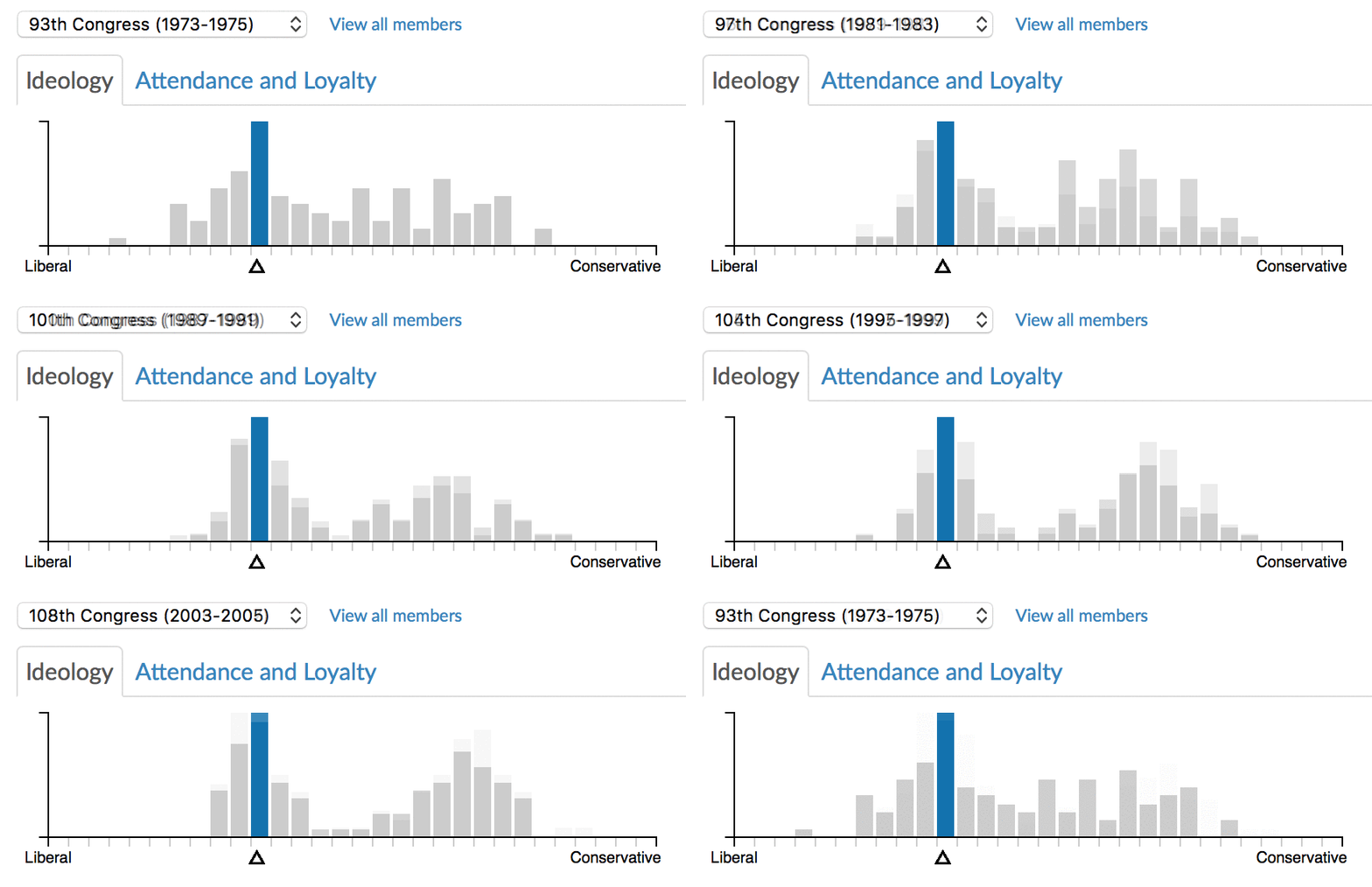
But his views have evolved with the party. The majority of Democratic senators voted for the Defense of Marriage Act (32 of 46), the Violent Crime Act (54 of 56) and the Anti-Drug Abuse Act (49 of 54). In fact, tracking his voting records through Congress, Biden is dead center of the Democratic caucus:

A .gif showing Biden's votes in the Senate, falling largely in the center of the Democratic caucus.

(the left bloc generally represents Democratic senators, the right bloc Republican senators. Biden’s position among them is marked in blue. On average, Biden was more liberal than 51% of Democratic senators and more conservative than 49% of Democratic senators).

So the question of where Biden stands is, in its broadest sense, a question of where the Democratic Party stands—and there’s evidence to suggest that the party is further left than it’s ever been. Even if ideas like Medicare-for-all or the Green New Deal weren’t enough to win the primary, the discussions they sparked in public opinion and the ideas they proposed were the catalyst which carved out the space in which Biden’s plans now fall.

So What Are Biden’s Plans?

Biden’s campaign website features an extensive list of policy plans, many targeted at specific communities. After the primary ended, several of these plans were reworked or added to with input from activists, legislators, and prominent Democratic figures. A joint task force between the more establishment and progressive wings released guidelines on some major policy areas, and what Biden’s plans have become in response:

Education

Biden’s plans on education represent a drastic shift from the Obama-era policy, perhaps driven in response to Secretary of Education Betsy DeVos’ championing of charter schools. In K-12 education, Biden pledges a massive investment in public schools (especially Title I schools in low-income areas; his plan calls for tripling funding for those schools) and teachers, though he has not yet adopted the recommendation of stricter federal oversight on charter schools.

Post-high-school, while Biden has adopted the progressive tenet of free public college for all at least to a degree: his plan says that colleges will be free for families earning under $125,000, and that community colleges will be free for everyone. Beyond that, Biden says that he will work to reform the student loan system to reduce administrative burden and—like many other of his plans—specifically invest in colleges and universities that serve communities of color.

Economy

The task force called for a comprehensive plan that specifically addressed communities of color, which Biden’s campaign has made the fourth pillar of his “Build Back Better” program. Though it does not include some of the policies championed by Sanders and Warren such as a “wealth tax”, it embraces the role of government in creating jobs (and assisting economic recovery in the wake of the pandemic) through the creation of a Public Works Job Corps.

His current economic plan, of which more details are expected to be released soon, is also interconnected with many other areas such as climate change, where Biden’s platform details that infrastructure development will also be designed to electrify and decarbonize much of the US’ existing infrastructure.

Immigration

On immigration, Biden’s plans (and even the task force recommendations) fall most in line with his primary campaign: the idea that, as president, Biden will work simply to undo much of what Trump has done. Much of Biden’s immigration plans amount to a dismantling of the restrictions implemented since 2016, such as the travel bans on Middle-Eastern countries and changes to the asylum system which forced immigrants to wait in Mexico or other Central American countries while their cases are processed.

While Sanders made waves in the primary for calling to abolish ICE and decriminalize illegal immigration (making it a civil penalty rather than a criminal one), Biden makes no such pledges. He calls for expanding the visa system to make more potential immigrants eligible, and creation of an oversight panel on ICE—another sign that, while pushed by the left, he is not the “Trojan horse” for their policies that many Republicans have attacked him as.

Climate

In a primary which saw broad, sweeping climate plans from candidates like Gov. Jay Inslee of Washington and of course the Green New Deal championed by Senator Sanders, Biden was criticized by progressive groups like the Sunrise Movement for being less willing to take bold steps, especially on an issue that many young voters—a weak area for him—care heavily about.

Yet just a few months later, the presumptive nominee’s sweeping new climate plan has been largely hailed by those groups. For one thing, they had a hand in crafting it: Biden’s plan came about as a result of one of his unity task forces between the progressive and establishment wings of the party, including people like John Kerry and Alexandria Ocasio-Cortez, and parts of it are drawn heavily from Inslee’s comprehensive, 200-page-plus path he laid out in the primary.

And it’s likely climate where Biden carves out his path to being the “most progressive president since FDR”. For one thing, it calls heavily for both government spending and investment in public-works programs, and has been supported by large groups of organized labor.

That said, Biden has also made efforts to continue his appeal as a more moderate candidate; in Midwestern states like Pennsylvania and Ohio, he has stated that he will not ban fracking—something that more progressive Democrats have called for and Republicans have attacked them over.

Criminal Justice

Criminal justice and police reform is another issue where the party (and public opinion) has shifted rapidly following the killing of George Floyd and nationwide protests. And once again, Biden has not moved as far left as some prominent Democratic figures: he doesn’t agree with completely “defunding the police”, and has stated that some funding should be “redirected” to less confrontational services such as social workers or mental health counselors, and says that police forces today are too heavily militarized.

His platform is also a repudiation of the bills of the 1980s and 1990s that adopted a “tough on crime” stance, calling for billions in investments to reduce incarceration and end mandatory minimums for nonviolent crimes—an especially important step for a candidate long dogged by his votes for those bills, and as public perception shifts away from the ideals of “law and order” that President Trump has pushed in response to the protests.

Health Care

Joe Biden’s healthcare plan has shifted left as well: he proposes creating a public option for health insurance administered by Medicare. This is most similar to the option presented in the primary as “Medicare for all who want it”—a plan that would not abolish private insurance but allow another option, especially for low-income families or those who don’t receive employer-based healthcare.

Also among his healthcare plans, but less contentious among Democratic voters and activists, are plans meant to prevent pharmaceutical companies from overpricing the drugs and medication that many Americans need: Medicare would directly negotiate the prices for all purchasers,  as well as restrictions on launch prices and price increases.

Housing

The pandemic has exposed the cracks in the United States’ housing system, showing just how vulnerable millions of people are to losing their homes when uncertain times hit—it’s estimated that almost 40 million people are at risk of eviction as the federal moratoriums expire. In response, President Trump signed an executive order which instructs the relevant departments to ‘consider’ limiting evictions or providing more money in aid, but doesn’t necessarily force them to do so.

Biden’s plan is founded on the view that even stricter eviction bans are no more than a stopgap measure. It calls for an extension of the Section 8 housing voucher program, which provides vouchers to low-income families that landlords may redeem, that would make it fully universal rather than capped at whatever Congress allocates. Even under normal conditions, it’s estimated that three-quarters of eligible households don’t receive help because there isn’t enough money in the pool, and that isn’t accounting for a pandemic which puts millions more at risk. Making the program universal, like Medicare or SNAP, would mean that—in theory—everyone eligible for benefits would receive them.

Procedure

While not policy-specific, many of Biden’s proposals call for huge investments in government spending, and will face steep opposition in the Senate even if Democrats win a majority in the fall—and, perhaps spurred by the failure of many of Obama’s policies over budget concerns and the filibuster, many Democrats have signaled willingness to end the filibuster and allow deficits to rise, allowing major increases to the national debt.

In a way, Democrats are borrowing here from Republicans’ playbooks to change the rules of Congress when it benefits their party, such as the ending of ‘blue slips’ for judge confirmations and reducing the amount of debate each judicial nominee receives before the Senate must vote on their confirmation. And the same appears to be true of budget deficits and the national debt. Republicans have long held the mantle of the fiscally-responsible party, but the national debt has surged under Trump, and his former chief of staff Mick Mulvaney stated that the party’s position on deficits shifts based on who occupies the White House: “My party is very interested in deficits when there is a Democrat in the White House,” he said in an overseas speech. “Then Donald Trump became president, and we’re a lot less interested as a party.”

Facing such opposition, not to mention the unprecedented economic downturn caused by the coronavirus pandemic, Biden and Congressional Democrats seem less inclined to rein in the budget as they have previously. Even the Blue Dog coalition, a group of moderate Democrats who promote fiscal responsibility, have called the unprecedented government spending “necessary”. And Biden’s plans, calling for trillions of dollars in spending, have only increased in scale—he himself has not mentioned the national debt, but House lawmakers have concurred that now is not the time for it: “We should be using our strong balance sheet to borrow to stimulate the economy. And that may involve more programs like climate and transportation going into the Biden administration,” said Rep. Scott Peters (D-CA), the vice chair of the moderate New Democrat Coalition.

Of course, Biden’s exact approach to procedure will be unknown unless he wins the White House in November. But progressive groups are hopeful that, especially on sweeping legislation such as climate, they won’t see the same failure as with Obama’s climate bill—without 60 votes in the Senate, it never even came to the floor.

The Most Progressive President?

Biden’s plans have been compared to FDR’s of the mid-20th century, both for their large investment in public-works projects and their creation in response to a sharp and unprecedented economic downturn that has left record numbers unemployed (though for very different reasons). But comparing the two on a single one-dimensional spectrum from liberal to conservative leaves out a very important difference between them—while perhaps similarly bold on economic issues, Biden’s plans and stances are consistently far more progressive than FDR’s on social issues (including healthcare, education, climate change, criminal justice, and housing).

The New Deal coalition that propelled Democrats to power from 1932 to the late 1960s was based largely on economic issues, uniting disparate groups such as white, socially conservative Southerners with ethnic and racial minorities under broad economic plans that benefitted almost all workers—but to do so, the coalition largely suppressed differences on social issues. In essence, it was an economically-liberal coalition which contained both socially liberal and conservative members. And when it fell apart, it did so due to backlash in the South to the civil rights movement and racial integration.

Biden, in contrast, explicitly addresses both economic and social issues in his platform—social issues on which his change over the years is especially evident. And it may be that which sets his particular progressivism apart from presidents of the past.

Biden’s $775 Billion Plan for US Caregiving

Amidst the chaos of the pandemic, Democratic presidential candidate Joe Biden unveiled an extensive spending plan to address what he calls “a child care emergency.” With uncertainty about how to guard against infection and whether to even open up at all, caregiving facilities for both children and the elderly have certainly suffered as COVID rages on. Biden hopes to address this issue through a comprehensive but costly approach.

The Plan

As part of his broad economic recovery plan, Biden hopes to spend $775 billion in total to revitalize the caregiving economy over the course of ten years. In practice, the money would be used through state subsidies and tax credits for caregiving facilities. Although Biden’s plan certainly has relevance in bailing out a failing sector of the economy during the current COVID crisis, he hopes to aid the construction of new and upgraded facilities over the coming years.

Much of Biden’s plan is targeted at helping elderly and child care providers themselves. He hopes to enforce a higher federal minimum wage as well as higher state-level standards for those working at caregiving facilities. The plan mandates that caregivers and educators be provided up to 12 weeks of paid medical or family leave. Biden estimates the plan will create close to 3 million new education and caregiving jobs while simultaneously raising job standards.

A significant provision makes pre-kindergarten education and childcare universal for children ages 3 and 4. With a free child care option for very young children, families would foreseeably save thousands on child care and early education. Biden hopes to expand the Child Care and Development Block Grant, a fund designed to help low-income families provide their children with caregiving services. He would like to both lower the eligibility requirements for aid and expand its terms to provide for weekend, summer, and after-school services. In addition to universal access to pre-kindergarten care and education, Biden’s plan addresses logistical concerns about care facilities. In order to mitigate the possibility of commutes that are too long for parents, Biden has argued that the plan would involve a substantial increase in facility construction in many geographic areas. In some cases, the plan would support on-site caregiving facilities for working parents so children can be brought to work.

Furthermore, Biden’s plan allocates $450 billion to enhance the elderly caregiving. With about 800,000 senior citizens on the waitlist for care under Medicaid, funds would be dedicated to diminishing wait times. Biden has also been vocal in his desire to empower the elderly to make their own choices about caregiving. This means funding community service options that allow seniors to live at home independently. Biden has indicated that elderly caregiving services provided under his plan would include meals, rides to appointments, daycare programs, and making their house safer. All this is possible, he claims, simply by expanding upon an existing provision of the Affordable Care Act (Obamacare).

What do the Republicans think?

His plan certainly sounds good: increasing access to care, reducing prices, maintaining quality, and providing parents’ as well as seniors’ with more choices. However, critics of the plan point out that these benefits come at a substantial cost. In response to Biden’s unveiling of his plan, the Trump campaign quickly retorted that the “unaffordable left-wing agenda gets more expensive by the day.” Biden is relying on raising the $775 billion necessary for his plan by increasing tax compliance among high earners as well as eliminating tax breaks for real estate investors who have incomes over $400,000.

For fiscal conservatives, the massive increase in spending and taxes is unacceptable. Biden’s spending plan for caregivers was unveiled shortly after his $2 trillion climate action proposal. Taken together, his ambitions reflect a desire to drastically reshape the economy through spending. Liberals advocate for this approach, citing the New Deal as evidence that spending can create jobs and effectively uplift the economy out of a recession. Conservatives are not so sure.

If Biden is to successfully fend off criticism from the Republicans, he must demonstrate that the value of his spending plan truly outweighs the cost. As the election approaches, the caregiving plan gives more insight into the plans and priorities of a potential Biden administration. Time will tell if the American people agree.

Who Needs The WHO (World Health Organization)?

In another instance of what has been a trend during his presidency, President Trump announced last week that the United States would be terminating its relationship, and therefore its funding, of another international organization, this time the World Health Organization. Trump announced on April 15 that  “the WHO failed in its basic duty and must be held accountable” for its handling of the COVID-19 pandemic and that the United States would be leaving the organization. On May 29, Trump officially announced the end of US ties with the organization. This announcement comes during the middle of a global pandemic as not just the United States, but the entire globe struggles to deal with the effects of COVID-19, the virus which has already killed more than 376 thousand people worldwide.

The president’s announcement came as a result of what he considered failing to do enough to stop the spread of the virus when it first appeared in China, and from Chinese pressure on the WHO to mislead the world regarding the COVID-19 virus and its spread.

What is the WHO?

The World Health Organization is an agency of the United Nations responsible for public health. The organization was designed to allow coordination between member states on issues related to international health policy. Individual members of the United Nations make voluntary contributions to fund the organization with the majority of funding coming from the United States, who contributed over $800 million to the organization during the 2018-2019 cycle, more than twice that of the next largest contributor, the United Kingdom.

Trump’s Issues with the WHO

Not the first time the president has spoken out regarding an international organization and what he sees  as the United States being taken advantage of, Trump has expressed several issues with the WHO including:

  • Not holding China accountable for what seems to be inaccurate COVID-19 case counts, deaths, and the extent of the spread of the disease within China
  • Refusing to share accurate and timely data, viral samples and isolates, withholding vital information about the virus and its origins
  • Increased influence from China on the world stage and their increased ability to influence the WHO
  • Concerns about WHO officials’ praise of Chinese “transparency”
  • WHO ignoring warnings about the virus from Taiwan
  • WHO repeating claims by Chinese officials that COVID-19 can not be spread from person-to-person
  • Opposition from WHO officials on Trump’s travel ban on China

Critics of the organization have noted that more powerful countries with larger contributions are able to hold sway over the organization in ways that other countries may not be able to. Trump’s call to remove the US from the WHO as a result of China’s increased influence over the organization is reminiscent of the Soviet Union’s own decision to leave the organization during a period of the Cold War as a result of what it saw as too much influence by the United States. Still, the president’s announcement to leave during the time of a global pandemic has drawn criticism from many who see the move as endangering the WHO’s ability to support global efforts to work towards developing a vaccine for the COVID-19 virus.

Trump alleges that “Chinese officials ignored their reporting obligations to the World Health Organization and pressured the World Health Organization to mislead the world when the virus was first discovered by Chinese authorities.” Among Trump’s complaints is the slow response of the organization in the early days and their reliance on the Chinese government’s figures regarding the virus, figures that many authorities have questioned, not just Trump.

A WHO Without the USA

Trump’s call to end the United States’ involvement with the WHO has received both support and criticism from many inside the US and out. Among those supporting his decision are North Dakota Sen. Kevin Cramer and South Carolina Sen. Lindsey Graham. Cramer stated that he is “glad our taxpayer dollars will now be used for other global health efforts,” and Graham called cutting off funding at this time “the right move.”

Among those who have expressed issues with the president’s decision are West Virginia Sen. Joe Manchin III and Tennessee Sen. Lamar Alexander. Manchin has expressed his opposition to the president’s decision by calling the move “reckless”, but barring any opposition, Trump is committed to carrying out his plan. The US is the only member state that can legally withdraw from the WHO, and their exit prompts many questions as to how the WHO and its remaining member countries will respond and react. The US contribution to the WHO makes up approximately 14% of its total contributions, a significant chunk, and one that allows great influence over the organization. At this time, it is unsure whether the other member countries will increase the amount of their contributions to make up for the loss, or if the organization will continue on underfunded compared to what it is used to.

How This Could Affects The US

The US risks a huge loss in global influence with regards to health research and policy by leaving. As the largest contributor, the US holds great ability to influence and lead the organization, and leaving would forfeit much of that influence on the world stage. The loss of that influence undercuts the WHO’s ability to combat the virus and work towards developing a vaccine as quickly as possible.

Pulling out of the WHO due to criticism of Chinese influence may prove to be counterproductive for the US as the loss of the US in the organization will only create a vacuum that will be filled by even greater Chinese influence over the organization and global health policy. Rather than be at the forefront of global health policy, the US will see itself become a spectator to China’s rise.

Supporters of the move see this as an opportunity for the US to have greater control over where taxpayer money goes when it is applied to global health organizations. It can do this while eschewing the bureaucracy and red tape that comes from dealing with a large international organization such as the WHO and its increasing Chinese influence. The US can directly provide funding to hospitals, NGOs and other organizations dedicated to global health such as Doctors Without Borders or the Red Cross. Time will tell in what ways this decision by the president will affect the US, but the world will continue on in whatever way possible to develop a vaccine for the COVID-19 virus.