
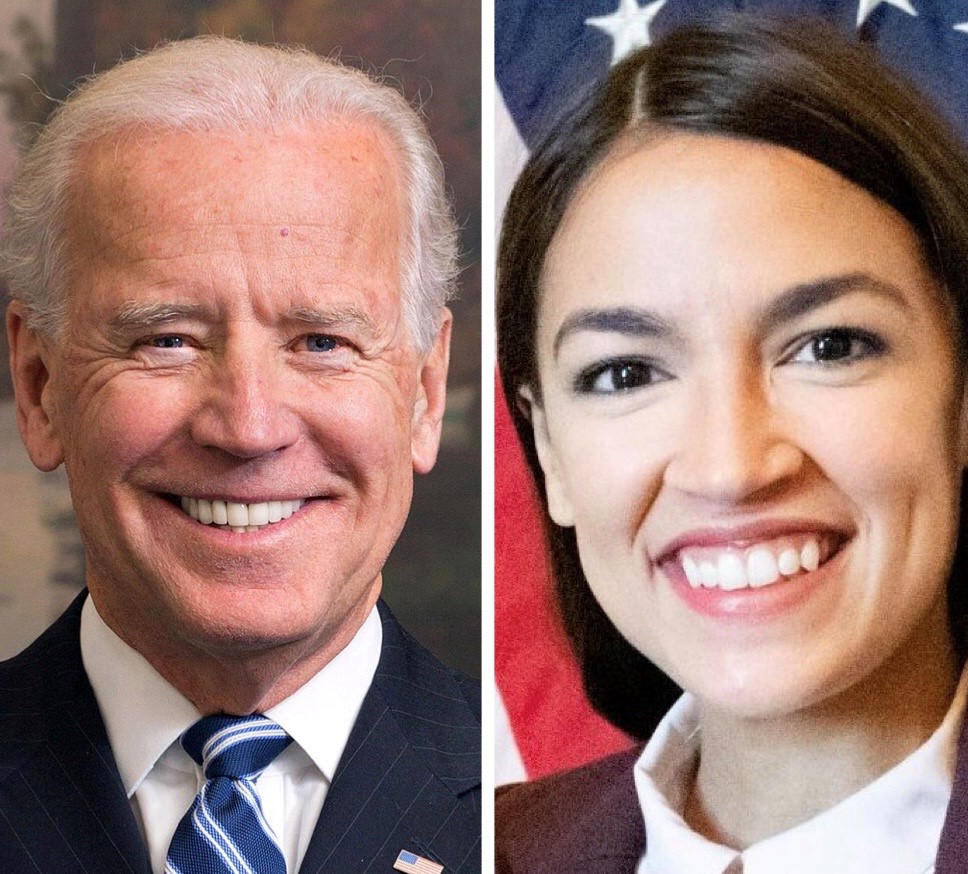
With the presidential election on the horizon, Democrat candidate Joe Biden commissioned a “joint task force” with Vermont Senator Bernie Sanders to develop a policy agenda. New York Rep. Alexandria Ocasio-Cortez (AOC) was among the most notable appointees of the task force. In addition to the explicit function of the working group to inform specific areas of policy, the joint task force serves as a symbol of unity between perceived moderates such as Biden and more radical Democrats such as Rep. Ocasio-Cortez. Some worry about the possible rift opening up between Democratic politicians and their policy preferences. A review of Biden and Ocasio-Cortez agreements and areas of contention help shed light on the varying stances within the Democratic Party.
What Are Their Policy Positions?
Some Democrats were disappointed with Biden’s reluctance to embrace a single-payer healthcare system in his approach to health care reform. He is not against citizens’ access to a public option. Rather, he advocates for maintaining the Affordable Care Act (Obamacare) and lowering requirements for those wishing to enroll in Medicare, providing more of a hybrid approach. AOC insists that Biden’s approach is not enough. Instead of accepting the status quo, she argues that a “Medicare for All” would be more successful in ensuring equal and affordable access to health care.
In addition to health care reform, Biden and Ocasio-Cortez differ in their stance on how to address climate change. Although they both agree on the need to rejoin the Paris Climate Agreement and to upgrade public transportation to accommodate climate change, they differ slightly in how they view emission quotas. Biden has proposed that the US reach net zero emissions by 2050. This plan lags 20 years behind AOC’s Green New Deal which calls for the country to reach the zero emissions quota in just 10 years. In addition, Ocasio-Cortez calls for the banning of fracking and natural gas while Biden does not.
Both Biden and AOC would like to implement the provisions of the College for All Act which would eliminate tuition and fees at public universities for all families below an income of $125,000. Comparing their overall stance on loan forgiveness, Rep. Ocasio-Cortez takes a decidedly more broad and simple approach. She advocates for wide-scale student loan forgiveness. In contrast, Biden would like to confine loan forgiveness to public universities and only up to a certain amount ($10,000 for each borrower during COVID). He also supports a plan where citizens are relieved after paying 5% of their income for 20 years.
In terms of their tax reform preferences, Ocasio-Cortez and Biden maintain a typical Democratic preference to increase taxes. AOC is somewhat more extreme in her view that the top marginal income bracket should confiscate 70% from top earners. In comparison, Biden simply hopes to reverse the top income bracket to 39.6% which reflects the tax rate before the enactment of President Trump’s tax bill, the Tax Cuts and Jobs Act of 2017.
One of the main aspects of Rep. Ocasio-Cortez’s platform involves the vocal denunciation of the Immigration and Customs Enforcement (ICE) due to the apparent inhumane treatment of illegal immigrants. Although Biden hopes to reform the agency and increase transparency, he does not see abolition as an effective approach. However, they are unified in their efforts to uphold DACA and their opposition to the construction of a physical wall on the Southern Border.
As part of “the squad,” a group of radical Congresswomen including Representatives Ilhan Omar, Ayanna Pressley, and Rashida Tlaib, Ocasio-Cortez has broken with the tradition of a pro-Israel stance in the Democratic Party. With concern for the oppression of Palestinians, AOC characterizes herself as defending the persecution of Muslims through the condemnation of Israeli foreign policy decisions. Despite no position on how to limit the sectarian violence experienced by many Muslims in the Middle East outside the lense of the Israel-Palestine conflict, she specifically speaks out against the Israeli occupation of the West Bank. In comparison, Biden takes a pro-Israel stance in line with mainstream Democrats such as Nancy Pelosi. He has praised President Trump’s recent brokering of the peace deal between the United Arab emirates (UAE) and Israel which codifies the UAE’s recognition of Israel’s statehood and lays the foundation for the normalization of economic relations in the Middle East.
The Future of the Democratic Party
With Rep. Ocasio Cortez’s affinity for progressive policies such as Medicare for All and the Green New Deal, she stands apart from the more moderate policies promised by a Biden administration. Proponents of AOC hope to elect Biden to eliminate the possibility of a Trump administration and pull him towards more progressive policies during his presidency. Thus, Biden is charged with balancing his own moderate preferences while appeasing those in the Democratic party who lean farther left. Many people point to young Democrats such as Ocasio-Cortez as a foreshadowing of a more progressive party platform as many people look to the future of the Democratic Party as a whole. However, it is not yet clear whether the rift between moderate and radical Democrats will serve as a means of higher accountability and innovative ideas within the party or whether it will simply hinder Biden’s ability to rally a large enough base to win the presidency.