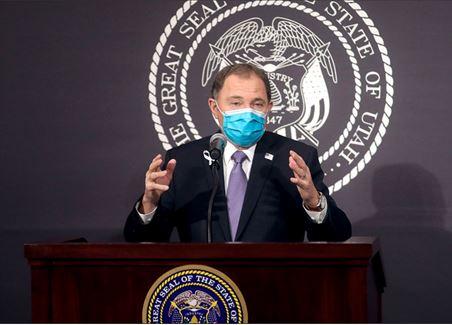
A slate of businesses, cities, counties, and states are imposing requirements that all people wear masks in order to slow the spread of the coronavirus—as of now, 33 states have some measure of mask mandates, as well as a patchwork of local restrictions in places without such statewide orders.
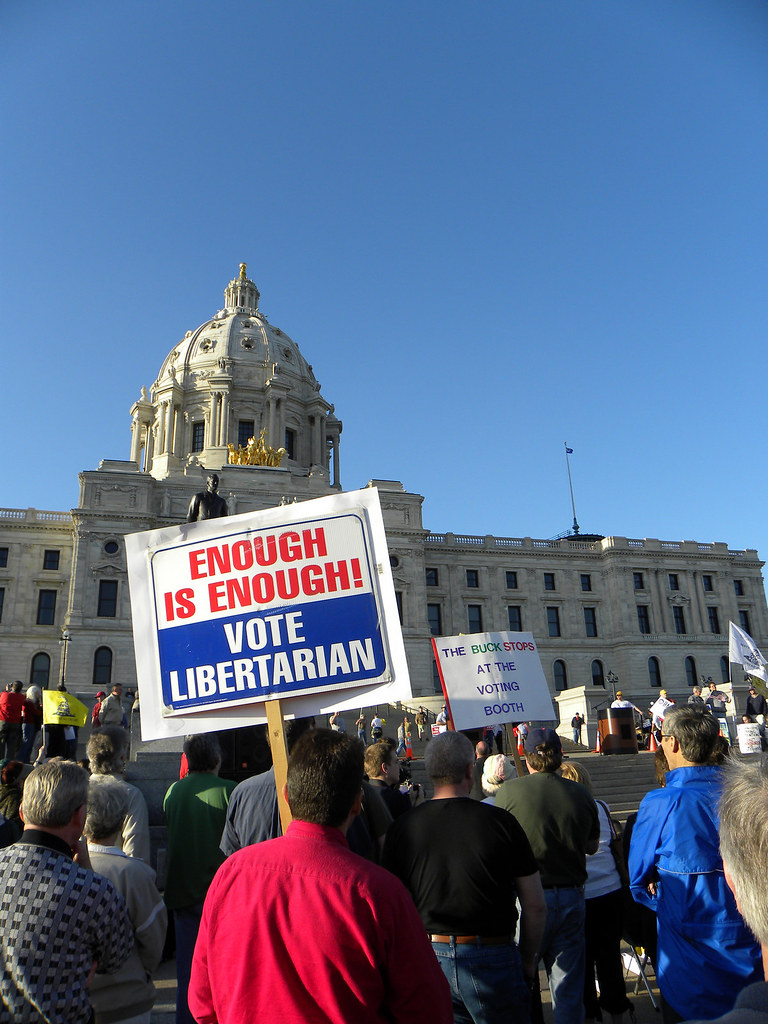
However, many Americans have refused, many citing claims that mask mandates violate their personal rights: a meeting in Utah County protesting the mandate for masks in K-12 schools drew national attention as attendees shouted: “mandates are against freedom”.
But are they?
Mask Mandates And The Constitution
A lawsuit in Florida states the new mask mandate “interfere[s] with … personal liberty and constitutional rights, including… freedom of speech, right to privacy, in addition to the constitutionally protected right to enjoy and defend life and liberty.” The lawsuit asks for a permanent injunction that would prevent the mandate from taking effect.
The First Amendment protects the freedom of speech, of the press, religion, assembly, and petition, and as Constitutional scholar, John Finn states, “mask mandates don’t violate the First Amendment.” A mask doesn’t prevent someone from speaking, and though it could be argued that it limits where and how one can speak, who they can reach with their words, those restrictions are not governed under the First Amendment as they do not restrict the content of the speech. “Time, place, and manner” restrictions already exist and have been upheld, such as laws preventing political campaigning near voting booths.
Another argument from farther north in Maryland is not that a mask mandate restricts speech, but that it forces speech. The District Court of Maryland disagreed, though, stating in Koa v. Maryland that “Requiring necessary protective equipment be worn to engage in certain public activities is simply not the equivalent of mandating expressive conduct.”
And the Constitution is more versatile than many believe. The Tenth Amendment gives states what is known as “police power”, which gives states the power to make laws to protect the “health, safety, and welfare of the public.” Finn cites the case of Prince v. Massachusetts, in which the Supreme Court found that parents could not use children to distribute religious pamphlets in violation of child labor laws, despite the argument that doing so violated the right to freedom of religion.
The other common objection is the “right to liberty”—the constitutional protection to individual autonomy. But, like the question of First Amendment rights, there is precedent to draw upon, drawing from the influenza pandemic a century ago and decades of rulings on vaccinations. In 1919, against a strikingly-similar backdrop of a deadly pandemic and public pleas to wear face coverings, the Supreme Court of Arizona stated that “Necessity is the law of time and place, and the emergency calls into life the necessity…to exercise the power to protect the public health.”
The ‘individual liberty’ argument has also been addressed via the state power to mandate vaccinations—most notably in Jacobsen v. Massachusetts, decided in 1905, in which the Supreme Court upheld a smallpox vaccine mandate in Cambridge, Massachusetts. Though the ruling is more than a century old, it still exercises considerable precedent over public-health rulings, forming part of the basis in the 2020 Supreme Court ruling in South Bay United Pentecostal Church v. Newsom, which upheld restrictions on religious gatherings in the face of the pandemic.
In South Bay, Chief Justice Roberts writes:
Our Constitution principally entrusts “[t]he safety and the health of the people” to the politically accountable officials of the States “to guard and protect.” Jacobson v. Massachusetts, 197 U. S. 11, 38 (1905). When those officials “undertake to act in areas fraught with medical and scientific uncertainties,” their latitude “must be especially broad.” Marshall v. United States, 414 U. S. 417, 427 (1974). Where those broad limits are not exceeded, they should not be subject to second-guessing by an “unelected federal judiciary,” which lacks the background, competence, and expertise to assess public health and is not accountable to the people.
In essence, South Bay—based on the Jacobsen ruling—gives wide latitude and deference to public health experts so long as the measures are neutral, generally applicable, and have clear justification. A mask mandate, especially in the face of a pandemic with “no known cure, no effective treatment, and no vaccine,” meets those requirements.
State Laws and Mask Mandates
Nor do mask mandates violate state constitutions and laws. Most states, such as Texas, have laws relating to disasters and public emergencies that give the government broad leeway to respond. All 50 states (plus Washington D.C. and four territories) have declared states of emergency, allowing them to receive additional aid from the federal government as well as impose restrictions such as limitations on gatherings and movement and mask mandates that would have been struck down in ordinary times.
And state laws also allow for businesses and localities to impose their own mandates, especially in places where the state at large has not yet required masks. Andrew Bibby, assistant director at the UVU Center for Constitutional Studies, says “People are surprised to find out how much power states have to make their own decisions when it comes to public health…most states allow their businesses to hang signs that say ‘No shirt, no shoes, no service.’ We should not be surprised if most states allow businesses to add ‘no mask.'”
This control of public health can be seen in ordinances restricting smoking, for instance: state governments and businesses are permitted to restrict when and where citizens may smoke because they have the authority to protect the health of the general public. In 2002, for example, an Ohio court found that no Constitutional protections upheld the “right to inflict health-destructive secondhand smoke upon other persons…”.
Finn concludes that our constitutional rights “are held on several conditions. The most basic and important of these conditions is that our exercise of rights must not endanger others (and in so doing violate their rights) or the public welfare”. During a pandemic, reasonable restrictions on our liberties are almost required because doing otherwise will almost certainly (and already has) infect and kill large numbers of our fellow citizens. And these reasonable restrictions are required because they work—in Utah, the most densely-populated county has seen its numbers fall after a mask mandate:

Even the famously libertarian Cato Institute states that restrictions such as mask mandates are necessary. “These sorts of restrictions end up maximizing freedom,” Ilya Shapiro writes. “The traditional libertarian principle that one has a right to swing one’s fists, but that right ends at the tip of someone else’s nose, means government can restrict our movements and activities because we’re all fist‐swingers now.”