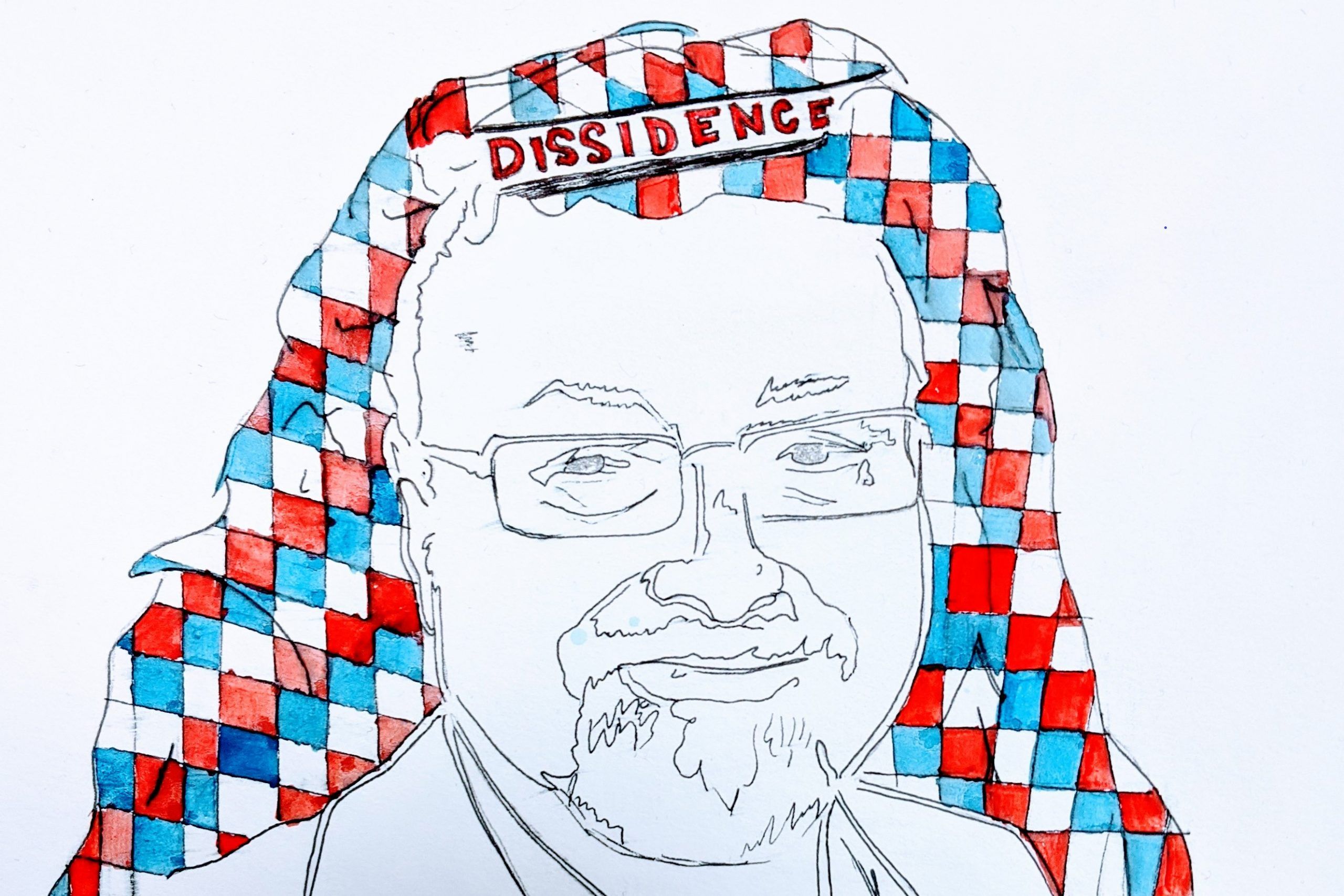
This piece on Jamal Khashoggi seeks to reflect the ideas portrayed in Thoreau’s Civil Disobedience. Though Thoreau’s ideas were published in 1849, his central claims maintain a key role in the American narrative today. In a modern perspective, Jamal Khashoggi is the martyr for the Civil Disobedience movement. Jamal Khashoggi was a Saudi dissident who dedicated his life to political reform for the people, by the people. Khashoggi was a columnist for the Washington Post and was outspoken against the Saudi crown and it’s repeated egregious human rights infringements, continuing to expose and persuade his audience to create a presence and make change. However, this very quality of exposure led to his assassination as he was killed and dismembered in the Saudi Consulate of Istanbul.
Khashoggi embodies Thoreau’s ideals as he seeks to inform every American and every person whom he can reach of his own experiences and hopes. Khashoggi becomes the modern day messenger of Thoreau’s principles as Thoreau says, “Let every man make it known what kind of government would command his respect, and that will be one step toward obtaining it.” (Civil Disobedience) Khashoggi spent his life’s work dedicated to informing and highlighting the injustices he and others suffered from. Khashoggi has made clear what kind of government will demand his respect. The only lingering question is whether we will listen.
Khashoggi’s death lead to subsequent articles and calls against the Saudi Government, but few came from the people themselves. It is simply indolent to claim that we as Americans “recognize [our] right to revolution”, for in the own words of Thoreau, “almost all [of us] say such is not the case now.” If the Washington Post and Jamal Khashoggi live by the words “democracy dies in darkness” then we as spectators must live the line of Thoreau: “[for] a man has not everything to do, but something.”
This art piece illustrates Jamal Khashoggi in his traditional checkered Keffiyeh, but in the colors of the American flag: red, white, and blue. The colors serve as the reminder for what Khashoggi fought and died for, the proliferation of American values. Khashoggi received a haven writing for the Washington post, and we as Americans must continue to defend those ideals that give America her maternal characteristics. Free speech and the right to peaceably protest are the government granted intrinsic qualities of Americans, but in Khashoggi’s own words, “it isn’t just the Middle East where freedom of expression is in jeopardy” (Washington Post, Khashoggi’s final column). Despite the rising denunciation from news organizations, Khashoggi’s assassination failed to bring the condemnation of the most paramount power on this planet, The United States Federal Government. In the weeks following Khashoggi’s death, his life was a story unwritten and unread.
The American people seem to have grown accustomed to solely absorbing horrific narratives that end with an oddly optimistic note. Jamal Khashoggi’s life will not follow this pattern. We as Americans must force ourselves to listen to the jarring minor discord that is now part of all our lives. Jamal Khashoggi was the modern-day flag bearer for the first amendment, but for now, it seems as though that flag is now a tattered, ripped piece of cloth that whips through the sky. If anyone is to ever carry that flag above their shoulders again, they will be forced to think twice.