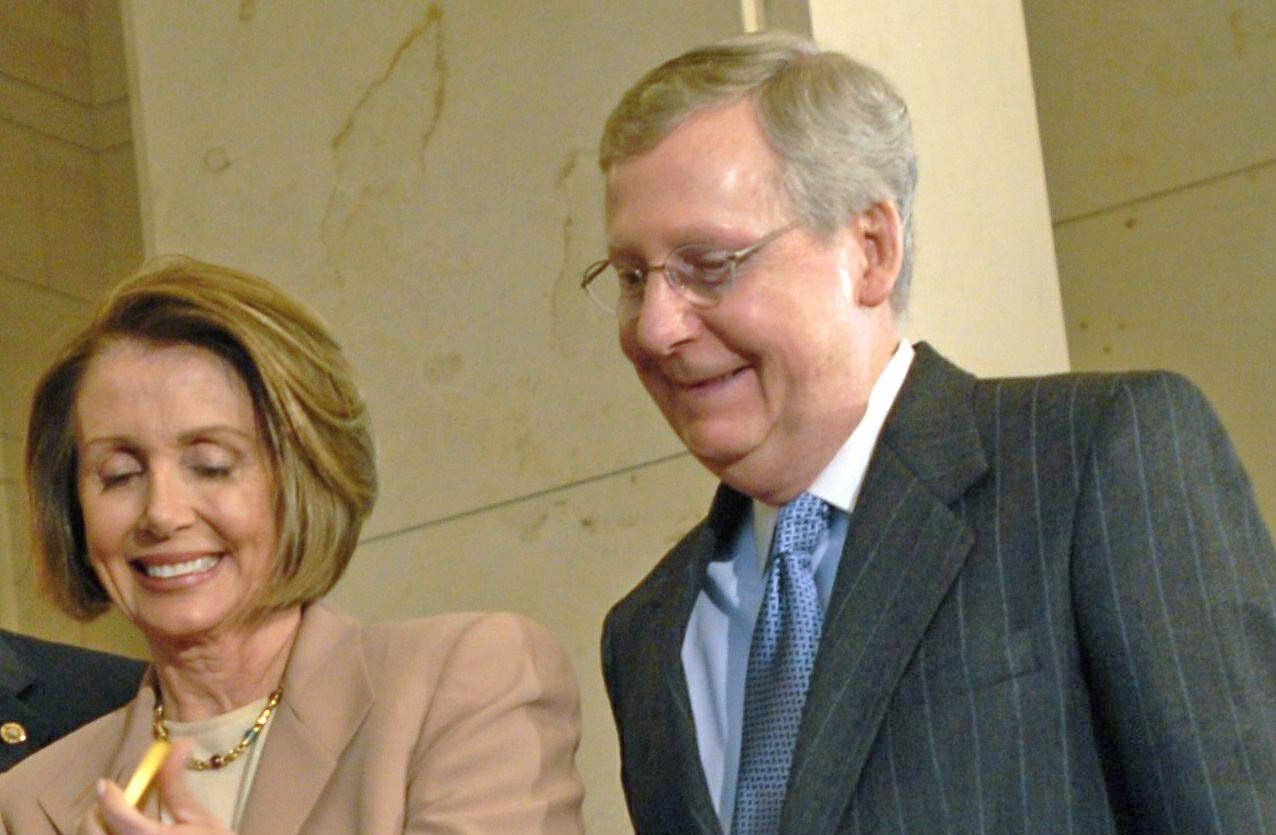
Mitch McConnell and Nancy Pelosi stand opposed to one another. Two years after the election of President Trump, a serge of anti-Trump fever pushed Democrat voters to switch the majority party in the House of Representatives. With a new Democrat majority, Pelosi was elected as Speaker of the House. In contrast, McConnell serves as the Republican majority leader of the Senate, effectively controlling the legislative program and schedule.
Although they both are leaders of the majority in their respective chambers of Congress, McConnell and Pelosi represent different parties with different aims. This directly puts the two at odds with each other with bills having to pass both the House and Senate.
Differences
Sen. McConnell and Speaker Pelosi disagree on virtually all partisan issues. You can count on Republican McConnell to stand up for the Second Amendment and Pelosi to pursue tighter restrictions on gun ownership. After each mass shooting, McConnell receives severe blowback from Democrats and the public for his stubborn conviction in the right to bear arms. He does not see gun control legislation as an impactful way to combat school shootings or gun violence in general. At one of Pelosi’s weekly press conferences, she blasted McConnell in response to his stalling of background-check gun reform by calling him a “Grim Reaper” due to his “killing” of bills that are passed in the Democrat-controlled House. Reinforcing this point, she stated that “the ‘Grim Reaper’ has decided that more people will die.”
Both do not see eye to eye on many foreign policy issues. Most notably, they have been engaged in a long-term gridlock on the Joint Comprehensive Plan of Action, commonly known as the Iran Nuclear Deal. The international agreement mandates that Iran halt operations conducive to the production of nuclear weapons in exchange for lifted sanctions and access to the international market for oil revenue. Although McConnell and Pelosi share the overarching belief that Iran should be stopped from developing or acquiring nuclear weapons, they differ on whether the Iran Nuclear Deal is an adequate means of achieving that objective. As Trump reimposed sanctions on Iran, McConnell supported the President’s abandonment of the agreement, arguing that increased pressure is the first step to re-negotiating the terms of a deal that has been flawed from the start. In contrast, Pelosi stands with fellow Democrats in pointing out that the US is violating the trust of its international allies by breaching the terms of an agreement. Furthermore, Pelosi warns that the Iranian government is likely to pursue nuclear development if the US continues to ignore its side of the deal.
Fiscally, McConnell has advocated for balancing the federal budget while Pelosi sees the need for increased government spending through infrastructure investment. In 2011, McConnell himself introduced a Balanced Budget Amendment for the Constitution, making it extremely hard to pass bills that raise taxes or spend outside specified limits. Pelosi voted against the amendment. Under McConnell, the Senate passed the Tax Cuts and Jobs Act of 2017 which effectively reduced personal and corporate taxes, with individual tax cuts diminishing over time and corporate tax cuts remaining permanent. Pelosi has sharply criticized the Republican tax bill for its disproportionate benefits for the rich. More broadly, McConnell’s conservative economic stance signals his faith in the free market to invigorate entrepreneurship and investment without government spending, taxes, or regulation. In contrast, Pelosi hopes to protect workers and middle class taxpayers through a more liberal approach to fiscal policy.
Considered one of his primary concerns, Mitch McConnell has maintained a staunch opposition towards increased campaign financing regulations. He believes that increased regulations protect incumbents and diminish participation in political campaigns. The Senator equates money with speech, essentially arguing that campaign donors are protected under the First Amendment. McConnell’s stance was eventually echoed in the Citizens United v. FEC case which prohibits the government from restricting political expenditures of corporations and other associations. Pelosi sees loose regulations on campaign financing as the reason why lobbyists and corporations have a stranglehold on Washington. In order to hold politicians accountable to voters instead of special interests tied to money, the Speaker of the House advocates for increased restrictions on campaign donations as well as better enforcement of existing regulations.
Finding Agreement
Given their mutual disdain for one another, it is incredibly hard to find areas in which Mitch McConnell and Nancy Pelosi can agree. However, both advocate for a pro-Israel stance internationally. Although Pelosi has opposed Israeli Prime Minister Netanyahu’s promise to annex the West Bank, by and large she is in favor of maintaining a strong alliance with Israel. Similarly, McConnell seeks to maintain and strengthen the US’ relationship with Israel. He has even gone so far as to condemn anti-Israeli sentiment from members of Congress such as Ilhan Omar.
Another area of concurrence is COVID relief legislation. Despite initial disagreement about the exact nature and extent of funding, they were both able to pass the Coronavirus Aid, Relief, and Economic Security Act (CARES) which provided trillions of dollars to address the COVID crisis. Given the need to pass legislation quickly, McConnell and Pelosi were eventually able to lead the majorities in their chamber to find common ground and gain bipartisan support.
Why the gridlock?
The ongoing fight between Pelosi and McConnell is not just petty politics. It highlights the foundation of our political system. Predicting the selfish and conflicting ideological interests of individuals and factions, our Founding Fathers created a system of gridlock. The inability to quickly pass legislation with counteracting people such as Pelosi and McConnell is certainly annoying and inconvenient. But, it is most certainly better than allowing one faction or idea to adopt a tyrannical position, passing any laws that they would like.