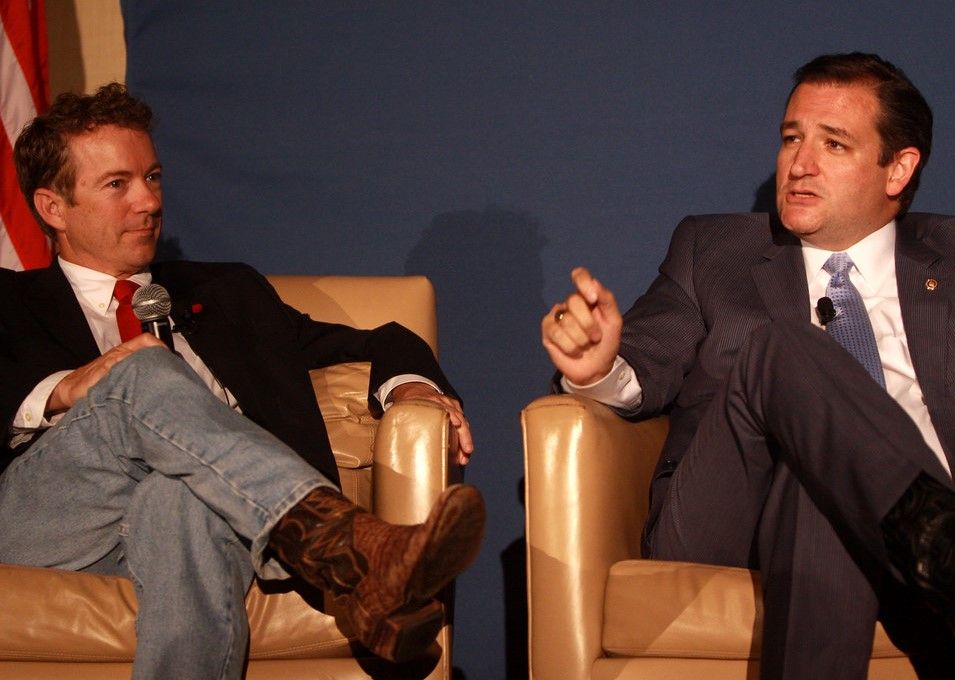
For many Americans, the last time Rand Paul and Ted Cruz were seen together was the 2016 Republican presidential debates. At some points in the political news cycle surrounding the Republican primaries, their drama and banter even rivaled the controversy surrounding Trump. But even harder to remember is the friendship the Senators shared going back to Rand Paul’s public endorsement of Ted Cruz during the 2012 Senate election in Texas.
Regardless of their ups and downs with each other, Rand Paul and Ted Cruz currently serve as Senators for Kentucky and Texas respectively. Cruz has even mentioned that he often sits next to Paul during the Senate Republicans’ daily lunch. In addition to the agreeable but unpredictable aspects of the two Senators’ friendship, their policy platforms provide key areas of concurrence and contention.
Differences
Rand Paul and Ted Cruz disagree on foreign policy. Sen. Paul maintains his ideal of small government regardless of whether he’s referring to domestic or foreign policy. He believes that the US should not police foreign affairs. Ted Cruz told ABC News’ Jonathan Karl “I don’t agree with him on foreign policy. I think U.S. leadership is critical in the world.” This means that whenever Cruz is faced with a foreign policy decision, he is likely to pursue a more aggressive approach. This can be seen in Sen. Cruz’s denunciation of the US taking part in peace negotiations with terrorists.
Ted Cruz and Rand Paul also differ on their views of marijuana. Rand Paul has advocated for a more liberal policy at the federal level as he was 1 of 3 Senators that introduced the Compassionate Access, Research, Expansion, and Respect States Act (CARERS) which would have legalized medical marijuana. Paul is also vocal in support for lighter sentencing on drug offenses. While Paul has opted for a libertarian approach, Cruz takes a notably federalist stance on the drug. Instead of taking action at the federal level in one direction or the other, Ted Cruz would rather let states individually decide.
More broadly, the difference between Cruz and Paul can be viewed through the lens of their appeal to voters. When announcing his bid for the 2016 presidency, Cruz did so at the biggest Evangelical Christian university in the country, Liberty University. In his rhetoric, Ted Cruz routinely brings up his Christian upbringing of a father who works as a pastor. Although this allows Cruz to rally a significant conservative base among states such as Texas that have a majority of Evangelicals among GOP voters, he has a much harder time appealing to non-Evangelical conservatives. In contrast, Rand Paul’s platform often attracts more than just conservative voters. He has introduced liberal legislation such as the Justice for Breonna Taylor Act which prohibits no-knock warrants in order to combat specific forms of police brutality. In addition to this bill, Paul has worked across the aisle with Democrats such as Cory Booker to seek criminal justice reform, another seemingly Leftist legislation. Although Paul has a better opportunity to broaden his base outside of his party, in comparison to Cruz, Paul’s liberal views certainly make him less popular among many staunchly conservative and Evangelical Christian voters.
Common Ground
In spite of their differences, the senators can certainly agree on a lot. Within the Republican Party, Paul and Cruz represent the anti-establishment wing. They are both members of the informal Tea Party Caucus, a group within the Senate Republicans that typically fosters members that are more conservative than their Republican counterparts. In addition, Rand Paul is a self-proclaimed libertarian conservative and Ted Cruz is considered a social conservative who tends toward libertarianism. Given this ideological overlap, the Senators ultimately agree that the present state of government is too big. Thus, they advocate for downsizing of government intervention with respect to both fiscal and social issues.
More specifically, in their pursuit of the idea of small government, both of the Senators would like to get rid of the Department of Education. Ted Cruz wants to go even further and get rid of the Department of Energy, the Department of Commerce, and the Department of Housing and Urban Development. In eliminating these responsibilities at the federal level, Paul and Cruz hope to delegate the power among these departments to state and local jurisdiction.
Another area of concurrence is their view on healthcare. Sen. Cruz and Paul both see the Patient Protection and Affordable Care Act (Obamacare) as a significant overreach of federal intervention. They both point out that Obamacare has vastly increased premiums and limited the number of choices that many people have. Instead, the Senators advocate for a free-market approach that creates competitive pricing and allows patients to choose private health insurance across state lines.
In terms of taxes, both are supportive of a flat tax rate. Rand specifically argues for a 14.5% income tax rate for all Americans while Cruz has advocated for a 10% rate. They would also like to abolish the Internal Revenue Service (IRS) which is a bureau under the Department of the Treasury that is responsible for collecting taxes and enforcing federal statutory tax law. In pushing for a flat tax rate and limited regulatory power, they seek to drastically simplify the system and create more equitable demands for taxes.
Their ideal of limited federal intervention and free markets also extends to other stances on the economy. They see regulations and taxation as interfering with capital gains and entrepreneurship. In addition to the siphoning of money directly, Cruz and Paul see regulation in the capital market as deterring investment. More broadly, they hope that decreased regulation of markets will incentivize individuals to start their own small private firms.
In pursuing their political platforms, the Senators are known for their prolific filibusters. Rand Paul’s longest filibuster of 13 hours helped push the confirmation of John Brennan as the director of the CIA off the agenda. Cruz stood and talked for a 21-hour filibuster to defund Obamacare. Reinforcing their similarity in Senatorial tactics, Ted Cruz was even at Rand Paul’s filibuster cheering him on.
Moving Forward
Paul and Cruz will be up for reelection in the years 2022 and 2024 respectively. They are likely to maintain their seats as they both have strong conservative bases in their home states. It’s possible that we even see one or both of them throw their hat in the ring for the 2024 presidency. Hate them or love them, it looks like their presenceーfilibusters and banter includedーwill continue being a facet of conservative libertarianism in the US Senate and Washington as a whole.