Last Thursday, Tom Cotton of Arkansas decried the bill to make Washington D.C. a state, dismissing it as an attempt to gain “two Democratic Senate seats in perpetuity”. However, even in that scenario, Republicans would maintain a majority: 53-49. Instead, Democrats are looking to a different path to attain a majority in Congress’ upper chamber, in thirteen races across the country:
The State of the Senate
Come November 2020, 35 Senate seats are up for re-election: twelve currently held by Democrats, and twenty-three held by Republicans. Of those twenty-three, Democrats believe they have a shot at flipping thirteen (though some have much longer odds than others):
In two states, the Democratic candidates lead in polls by double digits over the Republican incumbents. Colorado is a purple state that has steadily drifted blue, and former governor John Hickenlooper appears well-positioned to take on Cory Gardner, though he faced a primary challenge from Andrew Romanoff heightened by his decision to blow off a recent ethics hearing. The problem for Gardner is that US Senate races have become increasingly nationalized, and he’s tied himself to a deeply unpopular Republican president in a state that leans Democratic (unlike other senators such as Susan Collins of Maine, another Republican in a blue state, who is much more willing to criticize Trump).
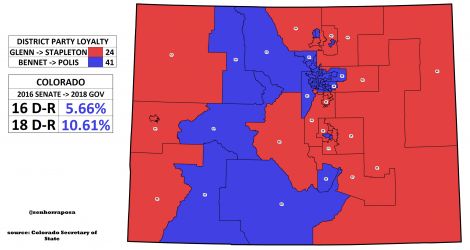
The polls reflect this: a survey in May, the most recent Senate poll, has Hickenlooper up by 18 points over Gardner. Even if the race narrows as November approaches, Colorado voters appear unlikely to split their tickets: there were no crossover districts between the 2016 Senate election and the 2018 governor election:
To the southwest, former astronaut Mark Kelly is well-positioned against Senator Martha McSally in Arizona, leading her both in fundraising (with double her cash on hand) and the polls (by 11 points on average). Unlike Colorado, the state isn’t particularly blue-leaning; it voted for Trump by 3.5 points in 2016, and 2020 polls show a thin margin between Biden and Trump.
So what explains the double-digit margin? Even though the state isn’t blue, it’s still trending towards Democrats—and it seems McSally hasn’t embraced those trends. Unlike John McCain and Jeff Flake, the Arizona senators in 2016 who criticized the president and provided key votes against him, McSally has been loath to criticize Trump. But the president isn’t popular in Arizona, and her decision to stick with Trump is likely key to the fact that Kelly is up 2-to-1 among moderates and 15 points among independents.
Rounding out the trio of Western states which are key to Democrats’ Senate chances is Montana, where Democratic Governor Steve Bullock is running against incumbent Steve Daines. And unlike Colorado, Montana is known for its ticket splitting: in 2016, the state voted for Trump by 20 points while also re-electing Bullock by 4 points; in 2018, Democratic Senator Jon Tester was re-elected by 3.5 points while the statewide race for the House went to Republican Greg Gianforte by 4.6 points.
Instead, Bullock’s chances may hinge on the coronavirus pandemic. Most governors have seen their approval ratings soar, and Bullock is no exception, garnering a 70% approval rating for his response and leading Daines by 7 points in the most recent poll (conducted early May). Much of that approval, however, hinged on the fact that Montana has the lowest coronavirus infection rate in the country, and that Bullock was able to begin a reopening earlier than most states. As the pandemic resurges in the US, Bullock needs Montanans to continue to believe that he is the one to lead them through it.
The Toss-Ups
There are three other states where Democrats hold a consistent if narrow, polling lead. In Maine, incumbent Republican Susan Collins, a self-described moderate who won her last election by 30 points in the slightly Democratic state, faces a much steeper challenge this time around. Much of her support among Democrats has dropped away with her support of Supreme Court nominee Brett Kavanaugh and vote to acquit Trump during his impeachment trial, but she’s also lost support among Republicans for criticizing the president, voting not to repeal Obamacare, and calling for witness testimony in that same trial.
She appears likely to face the Speaker of Maine’s House of Representatives, Sara Gideon; though the Democratic primary for the seat has not yet taken place, Gideon leads her nearest challenger, Betsy Sweet, by around 50 points in polling of the primary. In the general election, Gideon holds a narrow lead over Collins in polling—but both campaigns have the fall ahead of them to sway voters, in what’s expected to be the most expensive Senate race ever in Maine.
Besting it is the Senate race in North Carolina, set to be the most expensive Senate race ever between incumbent Republican Thom Tillis and former state senator Cal Cunningham. Tillis is seen as a uniquely vulnerable Republican senator, briefly boasting the lowest approval ratings of any Senator and unpopular among both Republicans and Democrats for his rapidly changing positions on the border wall, among other policies (he wrote an op-ed opposing the emergency declaration, and then refused to vote against it).
North Carolina is the only state where the senatorial, gubernatorial, and presidential races are all expected to be competitive; Cunningham holds a razor-thin lead over Tillis in the latest polls, Biden leads in a state Trump won in 2016 (and wants to again), and Democratic Governor Roy Cooper, who saw a spectacular rise in polling in the early days of the pandemic, now faces a challenge in his own lieutenant governor. The state is expected to lean back towards the Democrats, but both parties are expected to invest millions before November arrives.
Iowa is perhaps best categorized as the opposite of Colorado: a former swing state which has drifted red in the 2010s, though it still boasts a competitive Senate race. Democrat Theresa Greenfield faces Senator Joni Ernst and holds a narrow lead in the most recent polls. Ernst is another Senator who’s seen her allegiance to Trump handicap her election hopes—his approval rating has dropped dramatically in a state he carried by ten points in 2016, and hers with it.
Ernst’s main hope is that Greenfield is not well-known; she served as the president of a real-estate company and held no political office, meaning that a large group (almost 40%) of Iowans have little opinion of her. But the face that the race is competitive demonstrates the strength of the national political environment for Democrats, especially in a state that Trump won so decisively.
Expanding the Map
Several other races, mostly in red states, are seen as competitive, though the Democratic challenger holds no clear advantage. In Kansas, for example, Democratic hopes were buoyed by the success of gubernatorial candidate Laura Kelly in 2018 against unpopular Kris Kobach, who got the lowest percentage of the vote by a Republican candidate in a decade. While the race is still likely Republican, Democrats believe they have a shot because Kobach is also a frontrunner for the Republican nomination for Senate—Kobach is an extremely polarizing Republican even in Kansas for his hardline immigration policies and harsh view of voting rights, but faces a tight primary ahead of him.
The presumptive Democratic nominee is Barbara Bollier, a Republican-turned-Democrat who Democrats believe is their best shot at winning a reliably red state. In recent polls, she ran even with almost every front-running GOP candidate—but election analysts warn that this isn’t an indication of anything, as Republican voters haven’t yet coalesced around a candidate. When they do, Bollier faces a much more difficult fight for the Senate.
In South Carolina, Jaime Harrison, former state Democratic Party chair, faces an uphill battle to take on Republican Lindsey Graham, one of Trump’s most ardent defenders in the Senate. While other Republican senators have suffered for their loyalty to Trump, in South Carolina it has largely strengthened Graham’s position as one of the most popular Republican officials in the state. Recent polls and fundraising have been good for Harrison—he’s outraised Graham and is locked in a virtual tie with the sitting senator—but it’s hard to say whether that will be enough in such a red state.
Georgia has not one, but two Senate races this cycle (a regular election and a special election), both of which are shaping up in odd ways. The regular election features incumbent David Perdue up against Democrat Jon Ossoff, with both candidates locked in a virtual tie after Ossoff won his primary. Georgia, though a Republican state, is largely seen as trending Democratic—based largely on results from the 2018 gubernatorial election—and Democrats hope that trend will allow Ossoff to eke out a narrow victory.
The special election, however, is much messier. The primary for the seat is a “jungle primary”, meaning that candidates from all political parties appear on the same ballot, and the top two advance to November. But both the Republican and Democratic nominations for the seat are contested: Republicans between incumbent Kelly Loeffler and Representative Doug Collins, Democrats between Reverend Raphael Warnock and Matt Lieberman. But due to the quirks of the jungle primary, it remains a distinct probability that two Republicans, Collins and Loeffler, and no Democrats, could make the November runoff.
Another unexpectedly competitive race is the Senate seat in Alaska, where independent Al Gross (who would caucus with the Democrats if elected) is looking to unseat first-term Senator Dan Sullivan. Gross is a unique candidate—a doctor and fisherman who “killed a grizzly bear in self-defense when it snuck up on him” (according to his first ad)—and one whose presence has caused many to rethink their evaluations of the Alaska Senate race as safely Republican.
Gross also raised more money than Sullivan early in 2020, though Sullivan has more cash on hand, and the incumbent senator is still strongly favored. There are no recent external polls of the state—Democrats claim their polling shows Gross and Sullivan tied, while Republicans claim their own numbers don’t worry them.
Last, and probably least, are the Senate races in Texas and Kentucky. While they’ve garnered high-profile attention, especially Kentucky, where Senate Majority Leader Mitch McConnell is up for re-election, Texas and Kentucky are reliably red states, and recent polls put both Republican incumbents up by double digits over any challenger. While nothing’s impossible—Democrat Andy Beshear managed to win the governor’s mansion in Kentucky in a perfect storm, facing a deeply unpopular incumbent, and Texas is ever-so-slowly trending blue—these are not races that Democrats are likely to win.
Most cited polls have been aggregated here.